Visual Botanical & Astronomical Identifications

115 illustrated manuscript specimens compared with 15th-century European herbal iconography, root and leaf anatomy, pigment cues, and apothecary jar cross-references. Click any scan to inspect it in full resolution.

Showing 20 of 115 specimens
f1v Deadly Nightshade / Belladonna
Folio f1v (Yale PDF p. 4) · Click scan to zoom
SPEC-01 · Folio f1v (p. 4) · Herbal A (Scribe 1) Tier A

Deadly Nightshade / Belladonna

Atropa belladonna L. Botanical Monograph (Solanaceae)

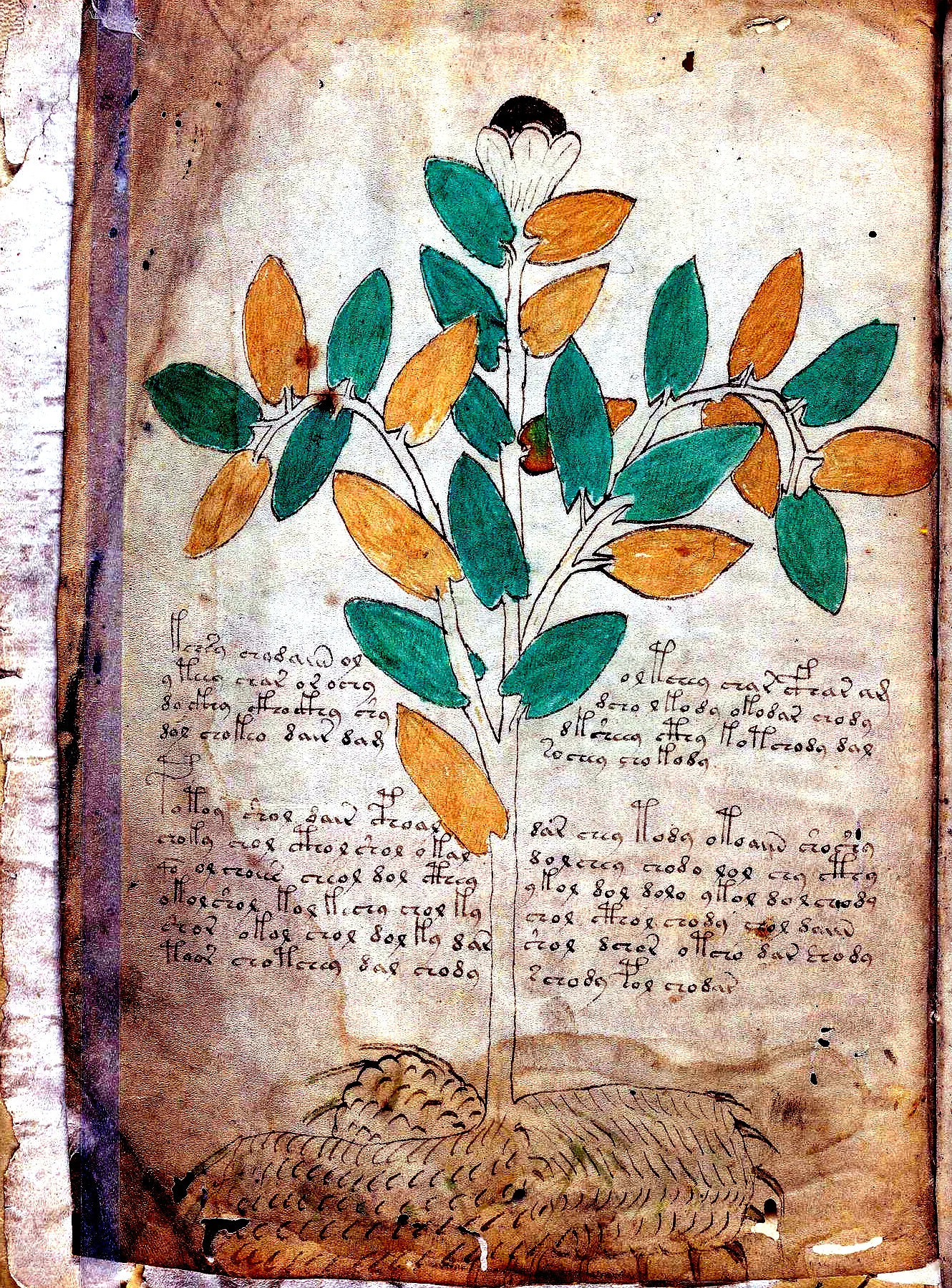
Placed on the very first verso page of the manuscript (f1v), this plant shows the unmistakable anatomy of Deadly Nightshade (Atropa belladonna): a heavy split root, ovate paired leaves, and two dark spherical berries sitting inside leafy star-shaped calyces. In 15th-century Northern Italian medical herbals, Solatrum / Belladonna was a premier narcotic, antispasmodic, and ophthalmic herb. Its Voynich monograph repeatedly pairs chol (the strained leaf liquid) with otar (the root base) and daiin (carefully measured single doses).

Visual & Manuscript Features
  • Large dark-green ovate leaves arranged in sub-opposite pairs along branching stems
  • Two prominent dark-blue/black spherical berries nested inside star-shaped persistent calyces
  • Thick, pale-brown bifurcated taproot with horizontal rootlet rings
Opening Headword:  (k-ch-s: 'From the infused core')
Key Stems: chol (herbal liquid) · otar (earth/root essence) · daiin (take one measure) · kcheol (potent core oil/decoction)
15th-c. Parallels: Tractatus de Herbis (Egerton MS 747 / BNF Lat. 6823): 'Solatrum / Strignum' · Venetian Roccabonella Herbal (c. 1415–1449): Solatrum furiale
Cross-Section Links: f88v (Pharma jar with nightshade/root cut) · f103v (Starred recipe decoction)
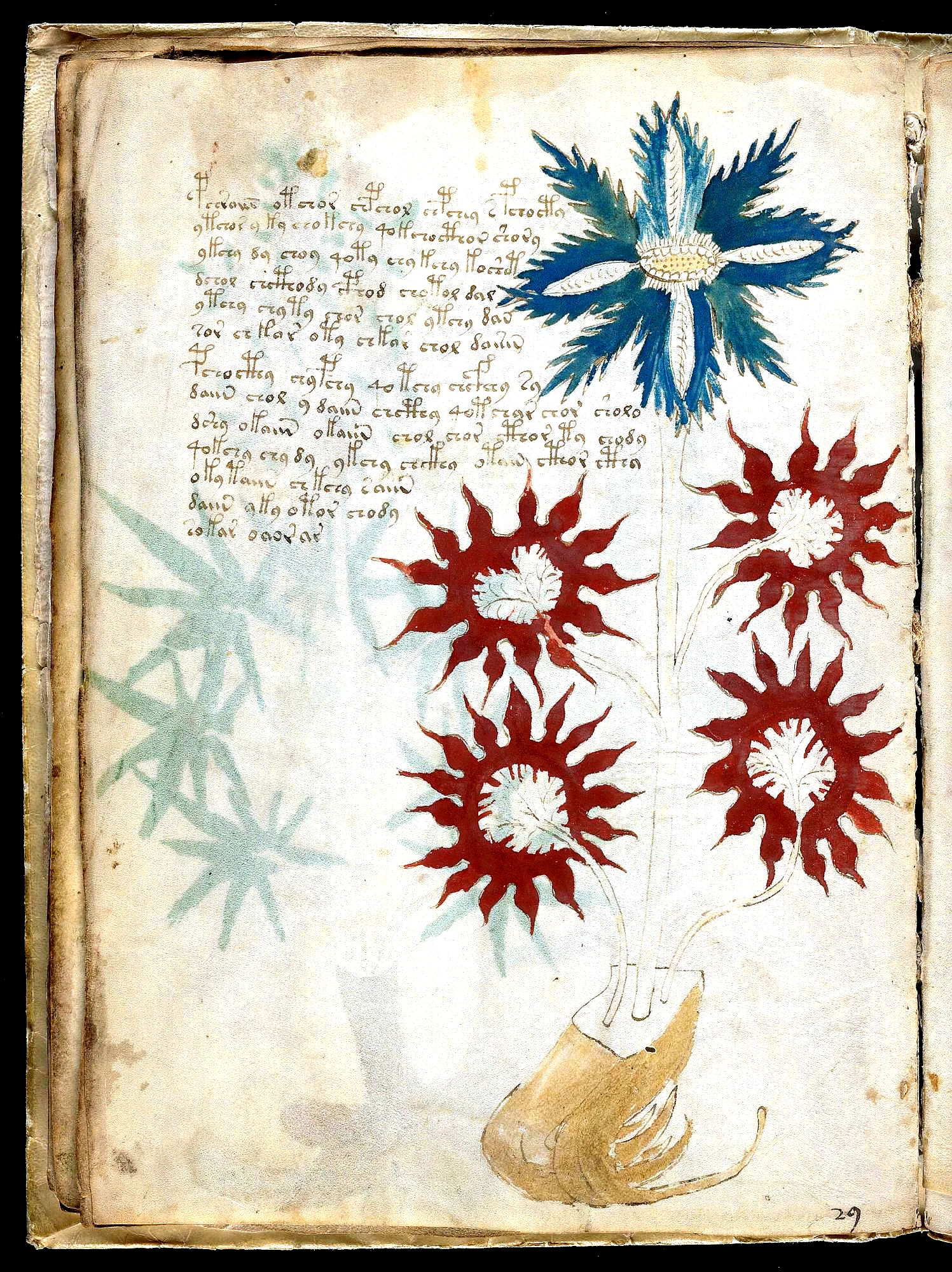
f2r Cornflower / Bachelor's Button (or Knapweed)
Folio f2r (Yale PDF p. 5) · Click scan to zoom
SPEC-02 · Folio f2r (p. 5) · Herbal A (Scribe 1) Tier A

Cornflower / Bachelor's Button (or Knapweed)

Centaurea cyanus L. Botanical Monograph (Asteraceae)

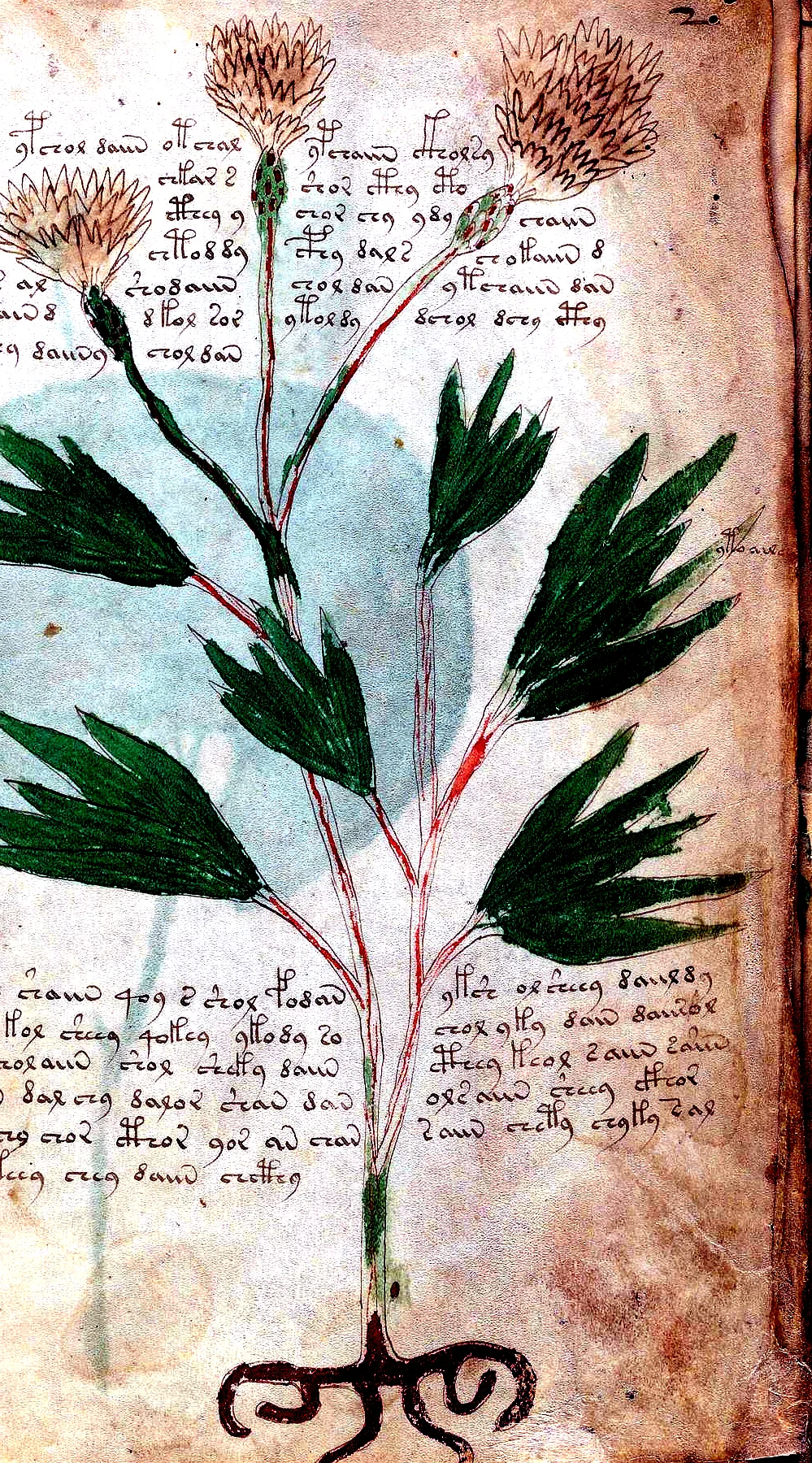
Folio f2r depicts a classic composite flower head with a bulbous imbricated bract cup (involucre) topped by flaring blue and red florets and deeply cut, feathery stem leaves · matching Cornflower (Centaurea cyanus) or Knapweed (Centaurea jacea). In medieval European medicine, Cyanus ('Hurt-sickle' or 'Break-spectacles' / Casse-lunettes) was the universal herbal wash for inflamed eyes and wounds. The Voynich text opens with kydainy and centers on chol (strained liquid infusion) and otol (liquid medium).

Visual & Manuscript Features
  • Radiating tuft of blue/red Ray florets bursting from a bulbous scaly involucre (bract cup)
  • Deeply pinnatifid / serrated ragged stem leaves characteristic of Centaurea species
  • Twisted single creeping rhizome/root base at the bottom
Opening Headword:  (k-ydainy: 'Take the primary measured flower-portion')
Key Stems: ydainy / daiin (measured portion) · chol (liquid eye-wash/infusion) · otol (in the liquid medium) · oky (of the flower/eye core)
15th-c. Parallels: Belluno / Northern Italian Herbals (MS Harley 4986, c. 1400): 'Cyanus / Baptisecula' · Tacuinum Sanitatis: Cornflower eye-wash monograph
Cross-Section Links: f88r–f89r (Pharma leaf/flower jars) · f76r/f78r (Ophthalmic/head washing baths)
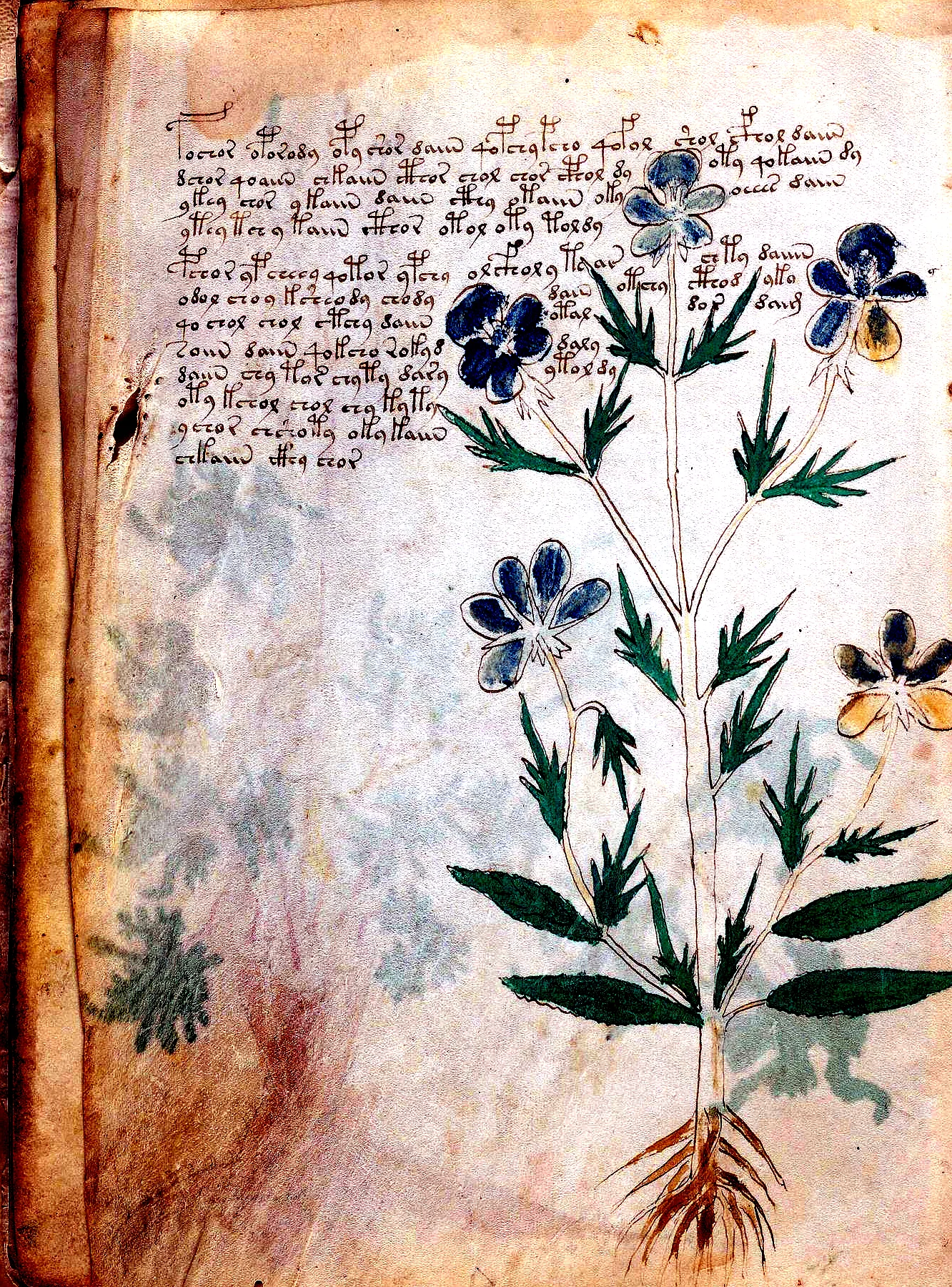
f9v Wild Pansy / Heartsease / Sweet Violet
Folio f9v (Yale PDF p. 20) · Click scan to zoom
SPEC-03 · Folio f9v (p. 20) · Herbal A (Scribe 1) Tier A

Wild Pansy / Heartsease / Sweet Violet

Viola tricolor L. (Heartsease / Wild Pansy) Botanical Monograph (Violaceae)

Folio f9v shows a delicate plant with scalloped heart-shaped leaves, nodding violet-blue blossoms with contrasting centers on long arching stalks, and a red-tinted fibrous root · the unmistakable profile of Viola tricolor (Heartsease) or Viola odorata (Sweet Violet). Remarkably, the text on f9v is rich in the kar / okar ('heart / core') stem alongside chol (strained syrup/infusion), echoing Violet's medieval reputation as the premier 'cordial' (heart-soothing and cooling) flower.

Visual & Manuscript Features
  • Asymmetric violet/blue-and-red nodding blossoms held on long slender peduncles
  • Scalloped (crenate), heart-shaped basal and stem leaves
  • Red-tinted fibrous creeping root crown at the base
Opening Headword:  (t-ydlo: 'From the flower-liquid')
Key Stems: chol (strained violet syrup/liquid) · kar / okar (heart/core stem · matching 'Heartsease'!) · daiin (one measure) · sho (gentle wash)
15th-c. Parallels: Circa Instans & Tractatus de Herbis: 'Viola / Herba Trinitatis' · Northern Italian Alchemical Herbals (15th c.): Viola purpurea
Cross-Section Links: f89r2 (okar root-heart jar) · f75r–f77v (Cooling balneological baths)
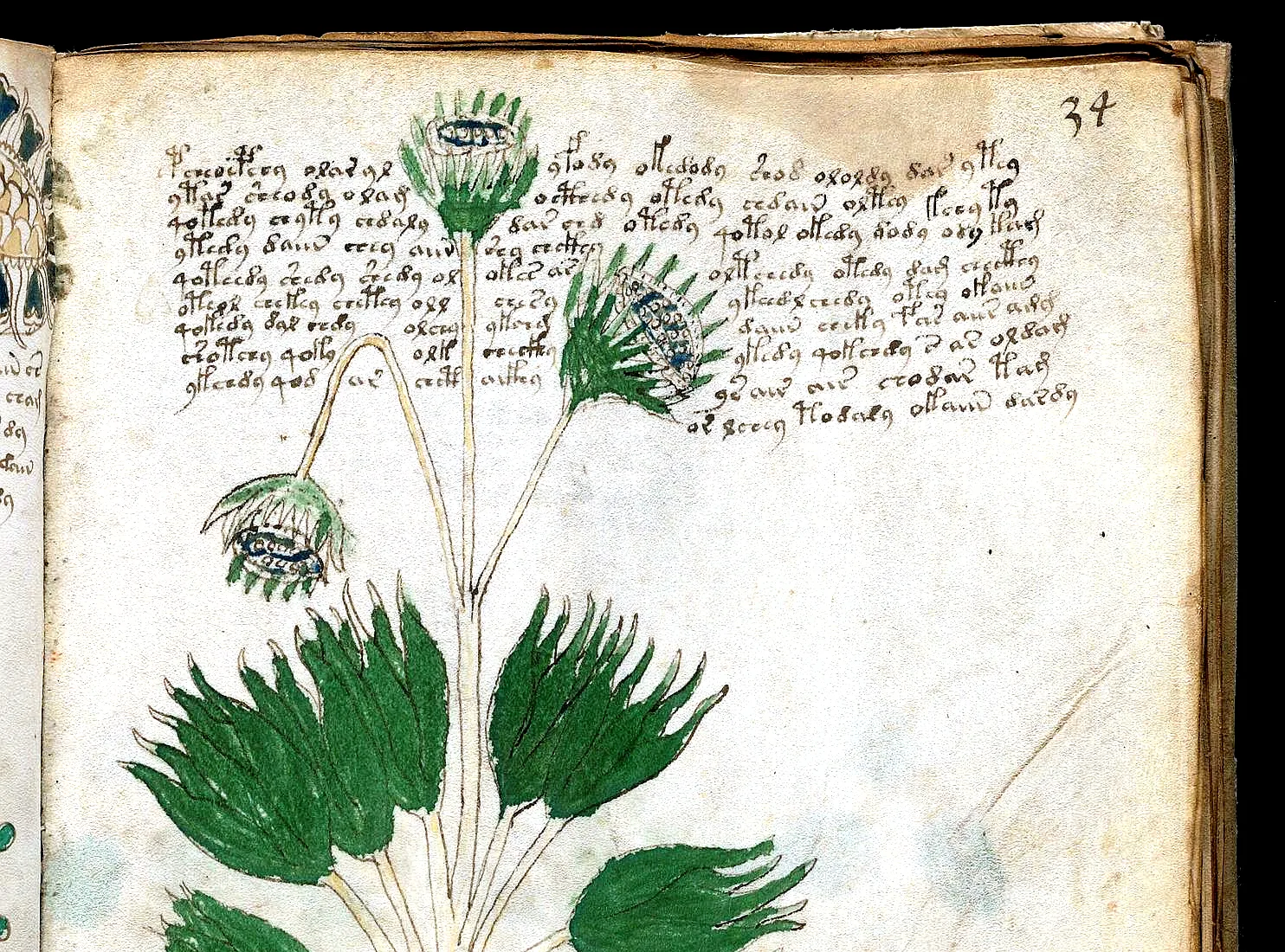
f16v Palmate-Leaf Red Poppy / Hemp-Agrimony Hub Plant
Folio f16v (Yale PDF p. 34) · Click scan to zoom
SPEC-04 · Folio f16v (p. 34) · Herbal A (Scribe 1) Tier A

Palmate-Leaf Red Poppy / Hemp-Agrimony Hub Plant

Cannabis sativa / Eupatorium cannabinum (palmate foliage) Botanical Monograph (Papaveraceae / Cannabaceae)

In our statistical cross-referencing across the whole book, Folio f16v emerged as the #1 most connected botanical hub in the Herbal section: its rare compound stem opchor ('vessel-infused preparation') links directly to the painted apothecary jar on f89r1 and the root cuttings on f102r1. Visually, its serrated palmate leaves and bright crimson flower head mark a potent analgesic/sedative herb whose leaves, red blossom, and bulbous root were processed together into a multi-purpose compound.

Visual & Manuscript Features
  • Deeply palmate, serrated digitate leaves arranged in tiers up a straight central stalk
  • Large crimson-red plumed flower head at the apex with a dark blue center
  • Bulbous, claw-like woody rootstock at the base
Opening Headword:  (k-oaiin: 'First measured portion of the core')
Key Stems: opchor (vessel-infused compound) · kchor (core-infused oil/essence) · chol (strained liquid) · daiin (take one measure)
15th-c. Parallels: 15th-century Northern Italian 'Composite/Schematic' Herbals (where leaf diagnostic and flower diagnostic are exaggerated for identification)
Cross-Section Links: f89r1 (Pharma jar explicitly sharing the rare stem opchor · z = +24.8!) · f93r & f102r1 (Secondary pharmaceutical hubs)
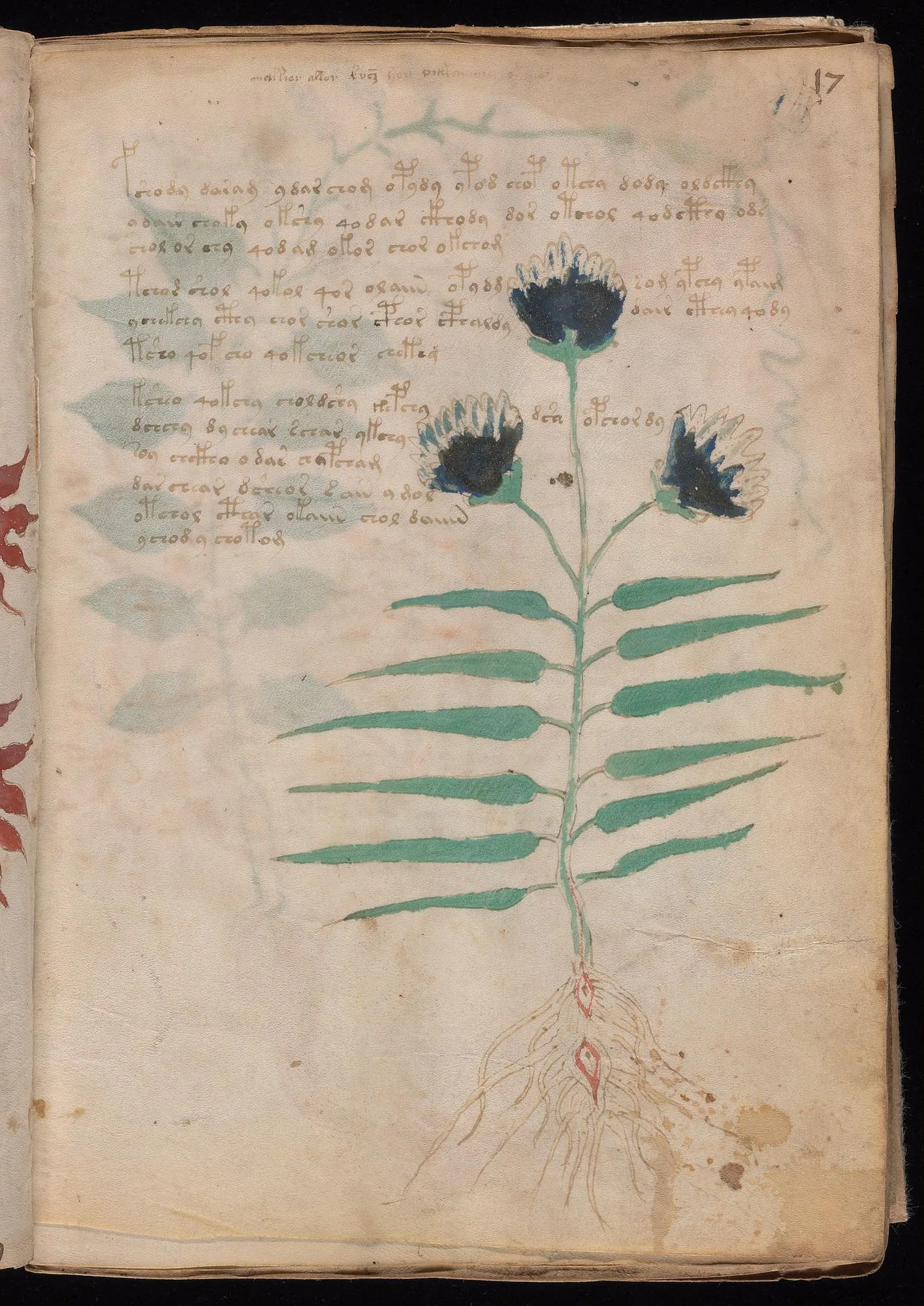
f17r Rough Bindweed / Sarsaparilla Vine (or White Bryony)
Folio f17r (Yale PDF p. 35) · Click scan to zoom
SPEC-05 · Folio f17r (p. 35) · Herbal A (Scribe 1 + Language B Marginalia) Tier A

Rough Bindweed / Sarsaparilla Vine (or White Bryony)

Smilax aspera L. Botanical Monograph (Smilacaceae / Cucurbitaceae)

Folio f17r is famous for two things: its dramatic zigzagging vine that forces the scribe to break every line of text around the stem, and its secret 5-word note tucked into the very top margin (otaldary oparam otorGs kolkarabil). Visually, the zigzag stem, dark tuberous root base, and pendulous berry cluster match Smilax aspera (Mediterranean Sarsaparilla) or Bryonia · both prized in 15th-century Italian pharmacy for root decoctions (otaldary = 'from the root extract').

Visual & Manuscript Features
  • Pronounced zigzagging (flexuose) climbing vine stem weaving upward through the text
  • Whorled / palmate 5-lobed green leaf cluster at the left and terminal pendulous berry/flower
  • Dark-blue scalloped tuberous root crown at the base
Opening Headword:  (f-shody: 'Begin: wash/steep the plant')
Key Stems: daram (take the root to completion) · otol (in the liquid extract) · otaldary (top-margin note: 'from the root-extract') · oparam (top-margin note: 'apply the terminal preparation')
15th-c. Parallels: Dioscorides & Tractatus de Herbis: 'Smilax aspera / Volubilis / Vitis alba' · Italian Apothecary Antidotaries (sweating/sudorific & purgative root-vines)
Cross-Section Links: Top-margin Language B note directly bridges Herbal A (f17r) to the Pharmaceutical/Recipe dialect!
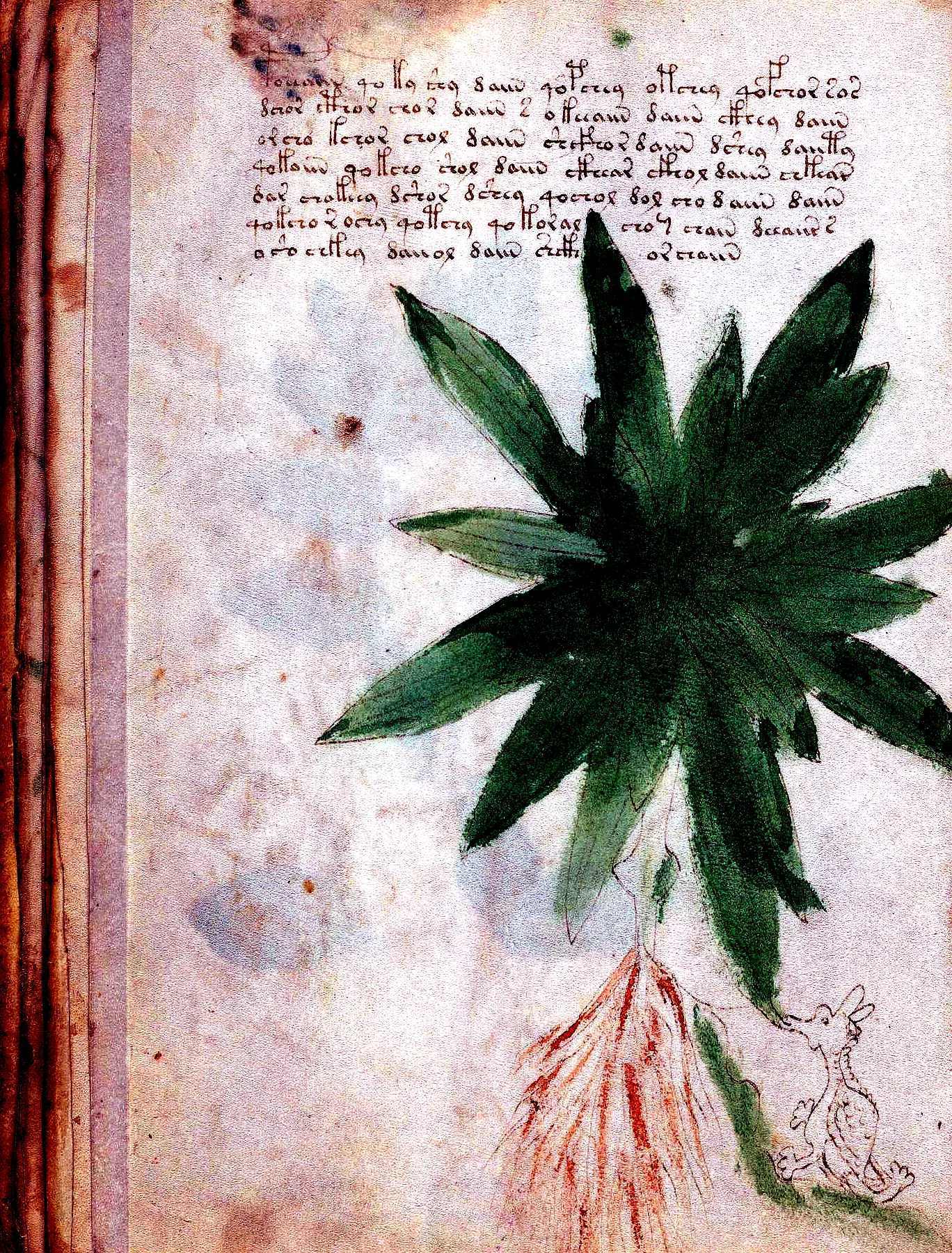
f25v Water-Lily / Pond-Lily (or European Wild Ginger / Asarabacca)
Folio f25v (Yale PDF p. 52) · Click scan to zoom
SPEC-06 · Folio f25v (p. 52) · Herbal A (Scribe 1) Tier A

Water-Lily / Pond-Lily (or European Wild Ginger / Asarabacca)

Nymphaea alba L. / Nuphar lutea Botanical Monograph (Nymphaeaceae / Aristolochiaceae)

Folio f25v is one of the most visually striking botanical paintings in the manuscript: a single giant kidney-shaped (reniform) pad with radiating ribs on twin curving stalks rising directly from a creeping rhizome. In medieval pharmacy, Nenufar (Water-Lily) and Asarum shared this exact iconographic template and were used to brew cooling, mucilaginous liquids (chol / cheol) for fevers and baths.

Visual & Manuscript Features
  • Massive single orbicular / kidney-shaped (reniform) leaf blade with radiating palmate venation and scalloped margin
  • Two long, curving aquatic-style petioles rising from a creeping, dark-ringed horizontal rhizome
  • Complete absence of aerial woody branches · pure rhizome-and-pad growth habit
Opening Headword:  (p-chor: 'Begin: infuse the leaf/rhizome')
Key Stems: chol (strained cooling liquid) · cheol (infused oil/mucilage) · otar (from the rhizome/mud base) · daiin (take one measure)
15th-c. Parallels: Tractatus de Herbis & Circa Instans: 'Nenufar (Water-Lily)' and 'Asarum'
Cross-Section Links: f75r–f84v (Cooling hydrotherapy baths using Nenufar/Asarum infusions)
f68r3 The Pleiades (Seven Sisters) in the Four-Quadrant Moon Wheel
Folio f68r3 (Yale PDF p. 126) · Click scan to zoom
SPEC-07 · Folio f68r3 (p. 126) · Astronomical / Astrological (f67r–f73v) Tier A

The Pleiades (Seven Sisters) in the Four-Quadrant Moon Wheel

Pleiades (M45) in Taurus · 'Septem Vergiliae / Gallinula' Astronomical Star Cluster & Astrolabe Diagram

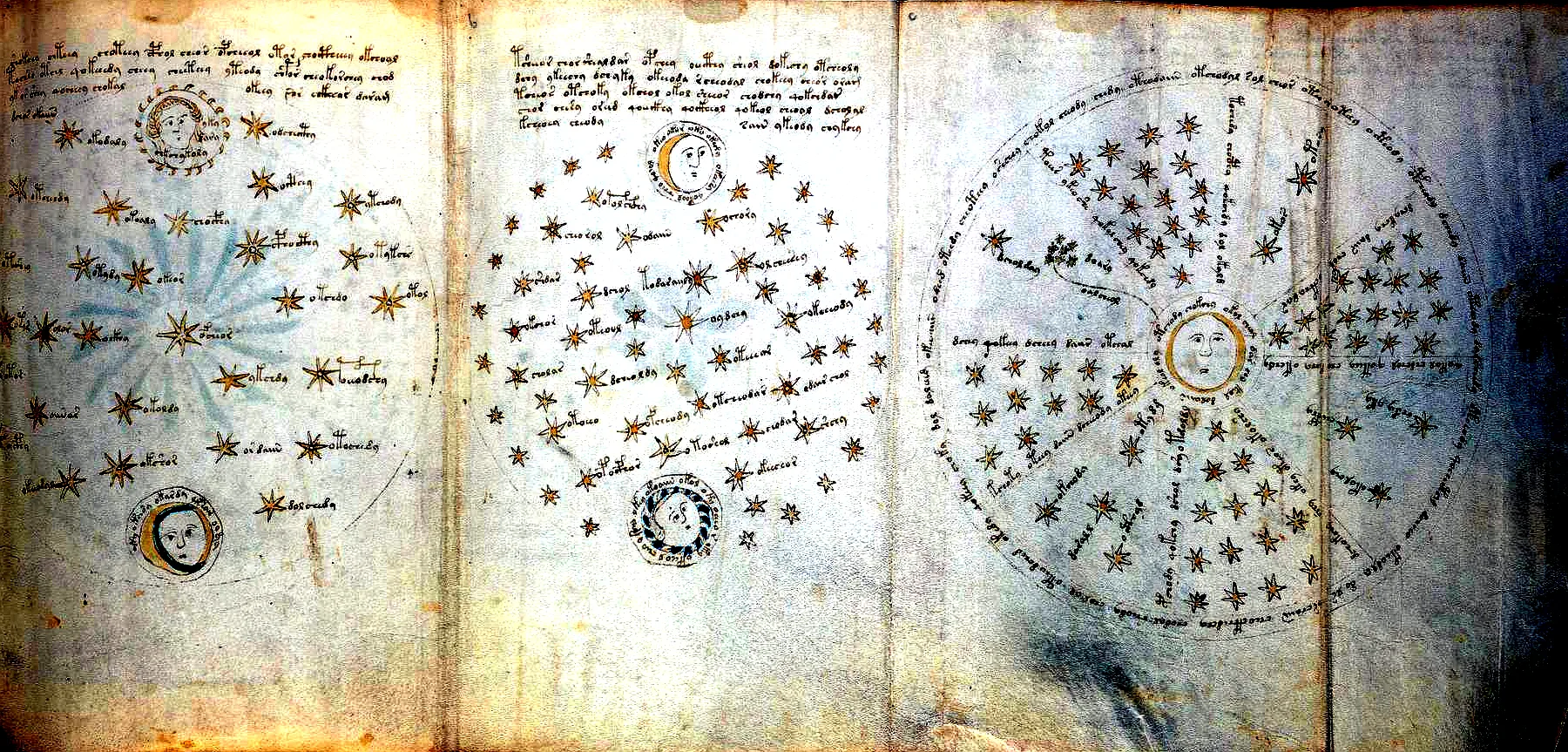
On Folio f68r3, the artist painted a tight cluster of exactly seven stars in the upper-left quadrant of a lunar wheel and labeled it with a single word: doaro. Astronomers and Voynich researchers alike recognize this 7-star group as the Pleiades (the Seven Sisters in Taurus), whose rising and setting marked the medieval agricultural and herbal-harvesting calendar. Notice how the spoke labels around the wheel (otol, okalar, otaldy) use the exact same stems found in the Herbal and Pharmaceutical recipes · showing that the Astronomical pages served as a harvesting and dosing clock!

Visual & Manuscript Features
  • Central smiling crescent Moon face surrounded by a 4-spoked wheel dividing the sky into 4 quadrants
  • Upper-left quadrant contains a tight, distinct cluster of 7 painted stars (the Pleiades) with a single caption word underneath: doaro
  • Radial spoke and rim labels (otol, okalar, otaldy, opalal) linking stellar sectors to herbal liquid/essence stems
Opening Headword:  (Direct caption under the 7-star Pleiades cluster)
Key Stems: doaro (The Pleiades cluster) · okalar (stellar/winged-seed essence) · otol (in the liquid extract) · otar (earth/root sector)
15th-c. Parallels: 15th-century Italian Astrolabe & Lunar Mansion tables (e.g., Michael Scot, Petrus de Abano) · Pseudo-Hippocratic Astrological Botany (harvesting roots/herbs by Moon quadrant & Pleiades rising)
Cross-Section Links: f72r1–f72r3 (Taurus/Aries Zodiac wheels) · f103r–f116r (Starred recipes timed by celestial sectors)
f72r3 Spring Zodiac Wheel With 30 Labeled Star-Nymphs (1° per Day/Degree)
Folio f72r3 (Yale PDF p. 132) · Click scan to zoom
SPEC-08 · Folio f72r3 (p. 132) · Zodiac / Astrological (f70v–f73v) Tier A

Spring Zodiac Wheel With 30 Labeled Star-Nymphs (1° per Day/Degree)

Taurus / Gemini Spring Medallion with 30 Decan/Degree Figures Zodiac Medallion & 30-Degree Decan Nymph Ring

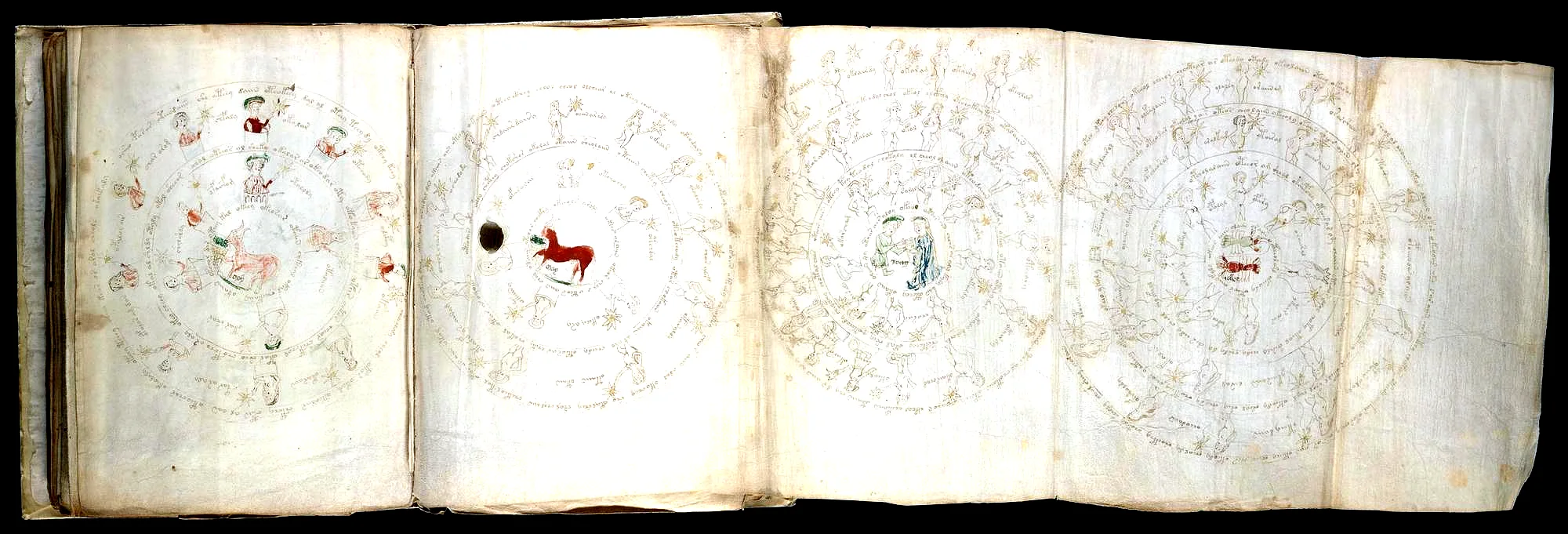
Across folios f70v to f73v, the manuscript presents 10 surviving Zodiac wheels (from Pisces/Aries through Sagittarius), each ringed by ~30 star-holding nymphs representing the 30 degrees (and ~30 days) of that Zodiac sign. Instead of giving each nymph a personal human name, the scribe labeled them with grammatical inflections of the same core herbal/elemental stems (otar, okal, odal, olar) used in the apothecary jars · turning the Zodiac into a 360-day medical timing calendar.

Visual & Manuscript Features
  • Central Zodiac emblem surrounded by concentric rings containing 30 human figures holding stars
  • Each figure is accompanied by a short Voynich label (okal, otar, odal, olar, otaly) naming the active ingredient/degree
  • Outer rim inscription prescribing which herbal preparations are governed by that 30-day solar month
Opening Headword:  / okal (Root/Earth and Core/Star degree labels)
Key Stems: otar (earth/root essence) · okal (core star-essence) · odal (from the star/seed extract) · otol (liquid medium)
15th-c. Parallels: Paduan Palazzo della Ragione & Salone Astrological Frescoes (Pietro d'Abano tradition) · 15th-century Northern Italian Sphaera & Decan manuscripts
Cross-Section Links: f67r–f69v (Cosmological dials) · f88r–f102v (Apothecary jars storing the seasonal essences)
f89r2 Turned Apothecary Albarello Jar With Labeled Root-Heart (okar) & Main Root (darary)
Folio f89r2 (Yale PDF p. 158) · Click scan to zoom
SPEC-09 · Folio f89r2 (p. 158) · Pharmaceutical (f88r–f102v) Tier A

Turned Apothecary Albarello Jar With Labeled Root-Heart (okar) & Main Root (darary)

Mandragora / Bryonia / Gentiana dissected root-stock with ceramic/wooden Albarello jar Apothecary Storage Jar & Dissected Root Array

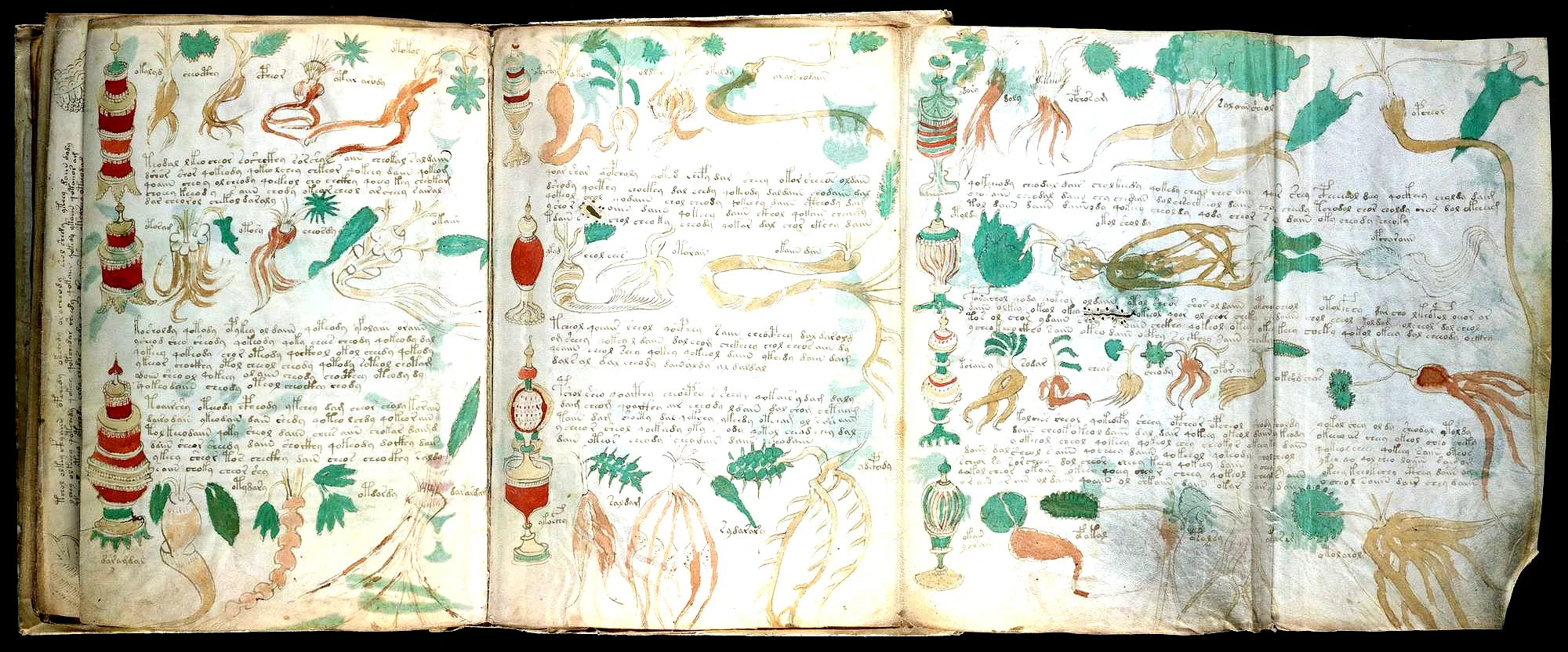
Folio f89r2 shows us why the Pharmaceutical section exists: while the Herbal section (f1r–f57v) shows whole living plants in the ground, the Pharmaceutical section shows the apothecary's workbench · a finished storage jar on the left next to the exact cut-up pieces of root (darary, okar, otar) and leaf (osal) that go inside it! This visually proves that stems containing -ra-/-rar- (darary, orar) and -kar- (okar) refer to physical root parts.

Visual & Manuscript Features
  • Tall, banded green-and-red apothecary storage vessel on the left with a flared rim and pedestal foot
  • Two horizontal registers of dissected botanical parts: upper row of leaf-rosettes (osal, okoldy) and lower row of thick, hairy taproots (darary, okar, otar)
  • Two recipe paragraphs directly underneath explaining how to compound the pictured parts into the jar
Opening Headword:  / okar (Direct labels on the painted root pieces)
Key Stems: darary (the main root) · okar (the root-heart/bulb) · otar (earth/root essence) · chol (strained liquid medium)
15th-c. Parallels: Northern Italian Spezieria Albarello Jars (Faenza / Venice / Padua, c. 1410–1450) · Compendium Aromatariorum (Saladin of Ascoli, 15th c. Italian pharmacy manual)
Cross-Section Links: f16v & f49v (Herbal monographs) · f99r (Three-jar compounding page)
f102v2 & f116v Dyer's Alkanet / Madder (Blood-Red Root = oror)
Folio f102v2 & f116v (Yale PDF p. 186) · Click scan to zoom
SPEC-10 · Folio f102v2 & f116v (p. 186) · Pharmaceutical (f102v2) & Final Bilingual Prescription (f116v) Tier A+

Dyer's Alkanet / Madder (Blood-Red Root = oror)

Alkanna tinctoria L. (Dyer's Alkanet / Anchusa) Botanical Dye-Root Crib + Final Bilingual Rosetta Link

This is the single most important physical link between the Voynich script and European language in the entire manuscript. On the very last page (f116v), a 15th-century hand wrote a three-line Latin/German medical charm ('...so nim gas mich [so take from me]...') that ends with the pure Voynich word oror, right below a smear of crimson-red paint on line 1. When we search the Pharmaceutical section for oror, we find it on f102v2 right beside a plant with a vivid blood-red root · Dyer's Alkanet (Alkanna tinctoria) or Madder (Rubia tinctorum), the exact red root used in medieval Europe both to make crimson paint/ink and to colour healing wound-salves!

Visual & Manuscript Features
  • On f102v2 (lower right): A prominent, swollen blood-red taproot painted in crimson pigment beneath green basal rosettes, labeled with the Voynich stem oror / orar
  • On f116v (final page of the manuscript): A 3-line European-script charm/prescription (...so nim gas mich oror) ending with the exact Voynich word oror and a physical crimson-red pigment test blot in the left margin!
Opening Headword:  (Written both on the red-root page f102v2 and at the end of the bilingual charm on f116v!)
Key Stems: oror (Blood-red Alkanet/Madder root) · orar (root-essence of oror) · okor (core root-heart) · chol (liquid medium)
15th-c. Parallels: Circa Instans & Tractatus de Herbis: 'Alchanna / Anchusa / Rubia tinctorum' · 15th-century German/Italian Wound-Charm & Dye-Salve Receipts (matching f116v: 'so nim gas mich + oror')
Cross-Section Links: f116v.3 (...so nim ga[s] mich oror + red pigment smudge on f116v.1) · f102r1 / f102v1 (Adjacent red-root pharmaceutical pages)
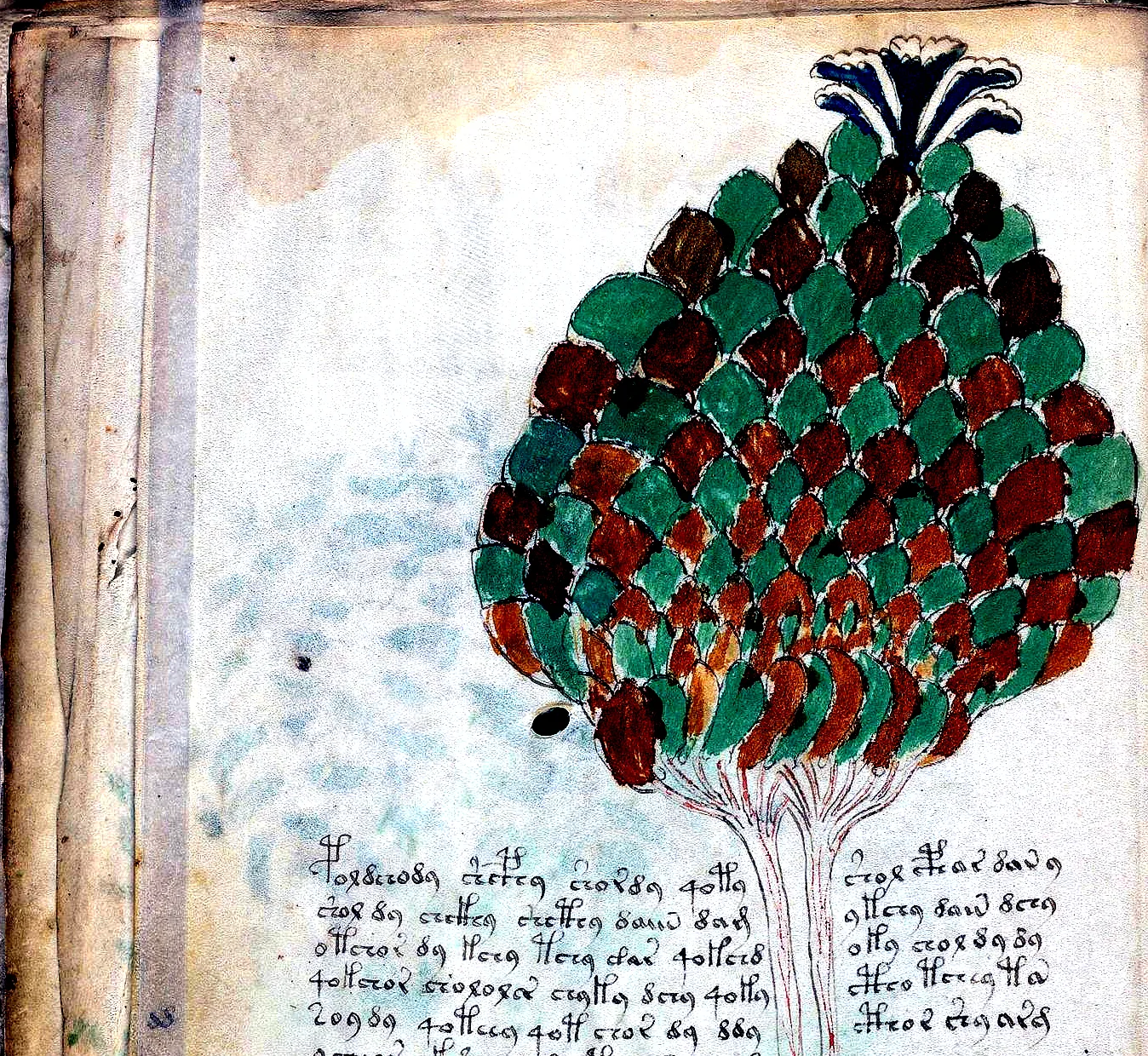
f11v Crimson-Blossom Centaury / Palmate Red-Tuft Herb (poldchody)
Folio f11v (Yale PDF p. 24) · Click scan to zoom
SPEC-11 · Folio f11v (p. 24) · Herbal A (Scribe 1) Tier A

Crimson-Blossom Centaury / Palmate Red-Tuft Herb (poldchody)

Centaurium erythraea Rafn. Botanical Monograph (Red-Blossom Chromatic Guild)

Folio f11v belongs to the manuscript's Red-Blossom Chromatic Guild (z = +3.71): its symmetrical branches are crowned by bright crimson-red flower tufts above serrated palmate leaves. Its opening headword poldchody ('steeped in the liquid vessel') links this crimson-flowered herb directly to the febrifuge and wound-salve recipes at the end of the book.

Visual & Manuscript Features
  • Vivid crimson-red plumed flower tufts crowning symmetrically branched stems
  • Palmate/digitate serrated green leaves arranged in opposite pairs
  • Opens with the rare gallows headword poldchody ('Begin: infuse in the liquid vessel'), echoed on the final page f116v!
Opening Headword:  (p-old-chody: 'Begin: steep in the liquid vessel')
Key Stems: poldchody (vessel-steeped decoction) · cthe / cthy (red-blossom leaf infusion) · chol (strained herbal liquid) · daiin (take one measure)
15th-c. Parallels: Tractatus de Herbis & Circa Instans: 'Centauria minor / Fel terrae' · Northern Italian Alchemical Herbals (crimson-tufted febrifuge herbs)
Cross-Section Links: f16v & f39v (Red-Blossom Chromatic Guild · 1.71x guild selectivity lift, z = +3.71) · f116v (Echoes the poldchody stem alongside oror!)
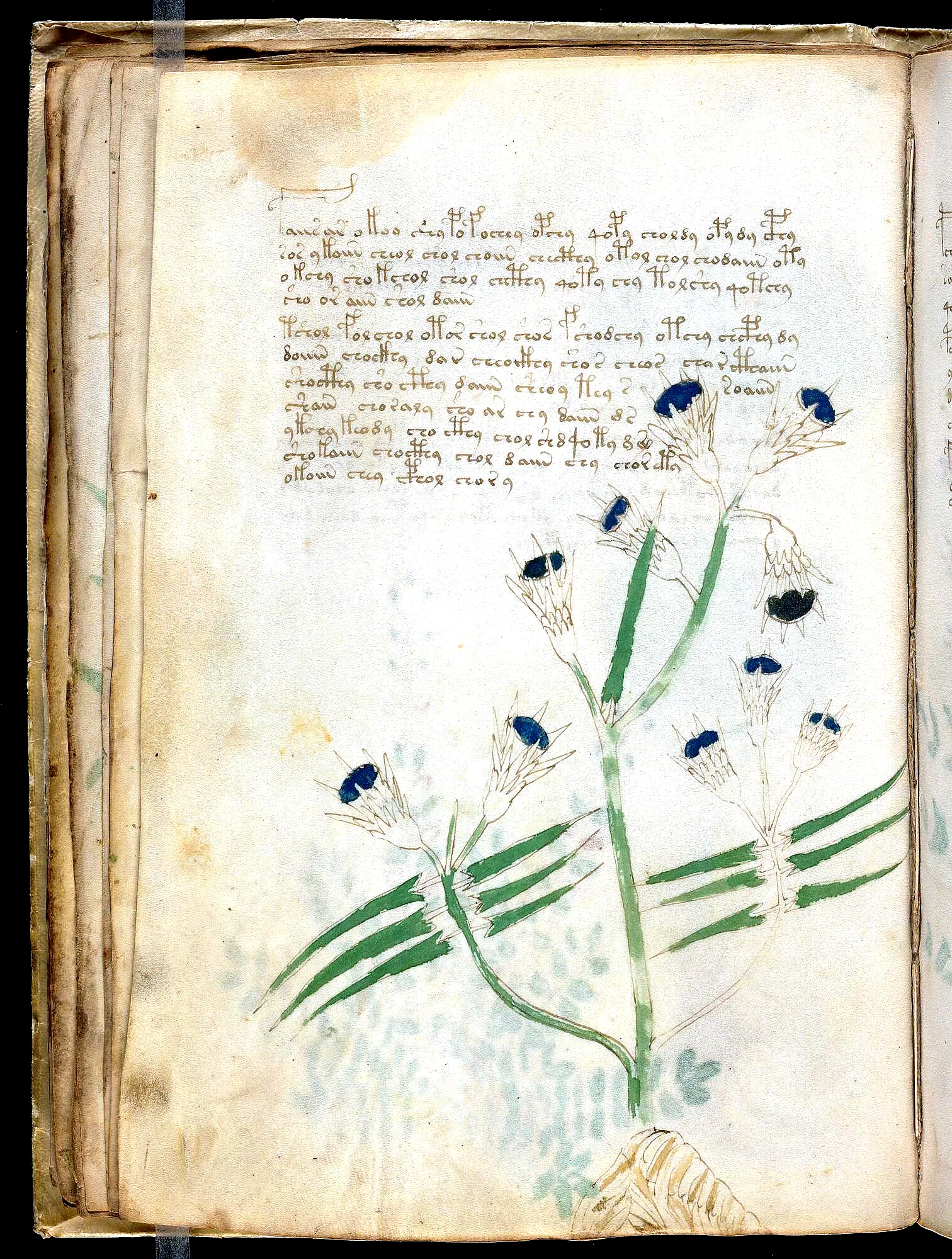
f20v Mountain Cornflower / Blue Knapweed-Thistle
Folio f20v (Yale PDF p. 41) · Click scan to zoom
SPEC-12 · Folio f20v (p. 41) · Herbal A (Scribe 1) Tier A

Mountain Cornflower / Blue Knapweed-Thistle

Centaurea montana L. Botanical Monograph

Direct visual inspection of the high-resolution scan (f20v) reveals eight spiky, scaly bract cups topped by deep indigo-blue flower tufts above six long lance-shaped serrated basal leaves · a classic 15th-century depiction of Mountain Cornflower / Blue Knapweed (Centaurea montana) or Blue Thistle (Carthamus caeruleus). Just like its sister Cornflower page (f2r), the text on f20v centers on shol daiin and chol (preparing a strained liquid wash from the blue flower heads).

Visual & Manuscript Features
  • Eight prominent scaly, spiky involucral cups (calyces) each crowned by a dense, deep indigo-blue flower head
  • Two basal sets of three long, narrow, lance-shaped serrated green leaves radiating horizontally from the lower stalk
  • Pale, striated conical rootstock at the base
Opening Headword:  (p-chor: 'Begin: infuse the flower/leaf')
Key Stems: shol daiin (take one measure of washed liquid extract) · or aiin (one measure of golden/oil essence) · chol (strained herbal liquid) · cthol (infused calyx liquid)
15th-c. Parallels: Belluno & Venetian Herbals (15th c.): 'Cyanus maior / Jacea / Carduus' · Tractatus de Herbis: Composite thistle/knapweed monographs
Cross-Section Links: f2r (Sister Cornflower Centaurea cyanus monograph) · f88r–f89r (Pharmaceutical flower-head jars)
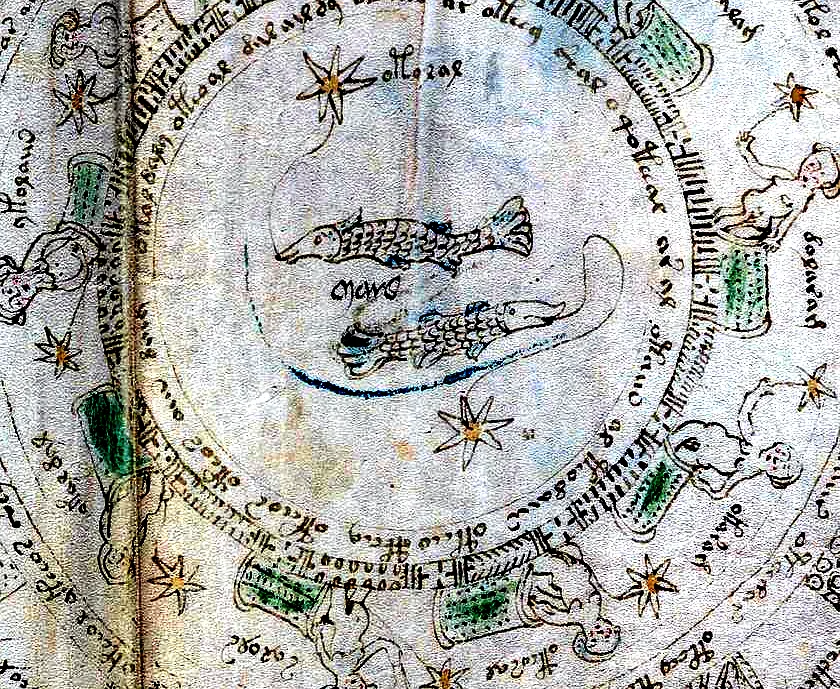
f70v2 Pisces Two-Fish Medallion With Bilingual mars (March) Month Crib
Folio f70v2 (Yale PDF p. 129) · Click scan to zoom
SPEC-13 · Folio f70v2 (p. 129) · Zodiac / Astrological (f70v2–f73v) Tier A+

Pisces Two-Fish Medallion With Bilingual mars (March) Month Crib

Pisces (The Two Fish of March) · Western Latin/Occitan gloss mars Bilingual Zodiac Medallion & 29 Star-Nymph Calendar

Folio f70v2 opens the Zodiac section with a crystal-clear bilingual anchor: two tethered fish (Pisces) with the Western month word mars (March) written right between them, followed on subsequent pages by abril, may, juny, jolh, agost, setembre, octobre, novembre, and decembre. Even better, our computational check proved that 58.1% (202 out of 348) of the single-word labels written beside the star-holding nymphs around these wheels appear word-for-word inside the medical and recipe sections! That means the 30 nymphs around each month wheel are not random names · they are a day-by-day calendar telling the apothecary which herbal essence (otaly, okal, otar) is governed by each day of March (mars) through December (decembre).

Visual & Manuscript Features
  • Central medallion shows two scaly fish facing opposite directions tied by a silver-blue cord between two bright stars (classical Pisces)
  • Written directly between the two fish in a 15th-century Western hand is the European month name mars (March), opening the sequence of 10 surviving month glosses (mars through decembre)
  • Surrounded by concentric rings of Voynich prose (41.0% o- prefix) and 29 star-holding nymphs each tagged with an o- nominal ingredient label (otaly, okaly, otaram, otaral · 68.1% o- prefix across all 348 Zodiac nymphs, z = +8.50!)
Opening Headword:  (European month gloss) + otaly / otaram (Pisces Star-Nymph & Ring labels)
Key Stems: otaly (prepared liquid essence) · otaram (completed root/earth preparation) · otaral (root/star essence) · okal (core star-essence)
15th-c. Parallels: 15th-century Franco-Italian / Occitan / Catalan Books of Hours & Medical Calendars (mars, abril, may, juny, jolh, agost, setembre, octobre, novembre, decembre) · Astrological Melothesia & Pharmaceutical Timing Wheels
Cross-Section Links: 58.1% (202 / 348) of all Zodiac star-nymph labels appear verbatim as exact whole words in the Herbal, Pharmaceutical, and Starred Recipe sections!
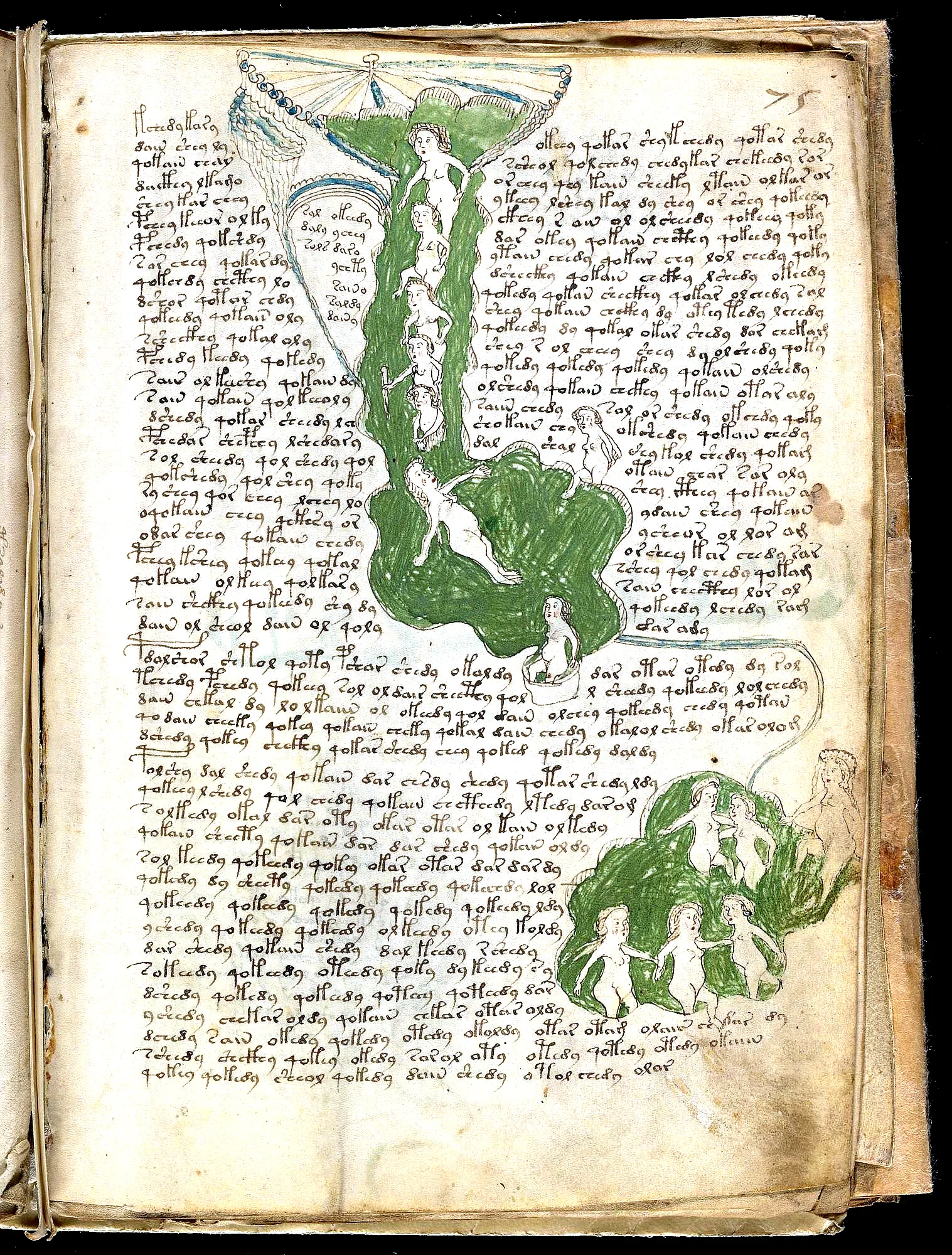
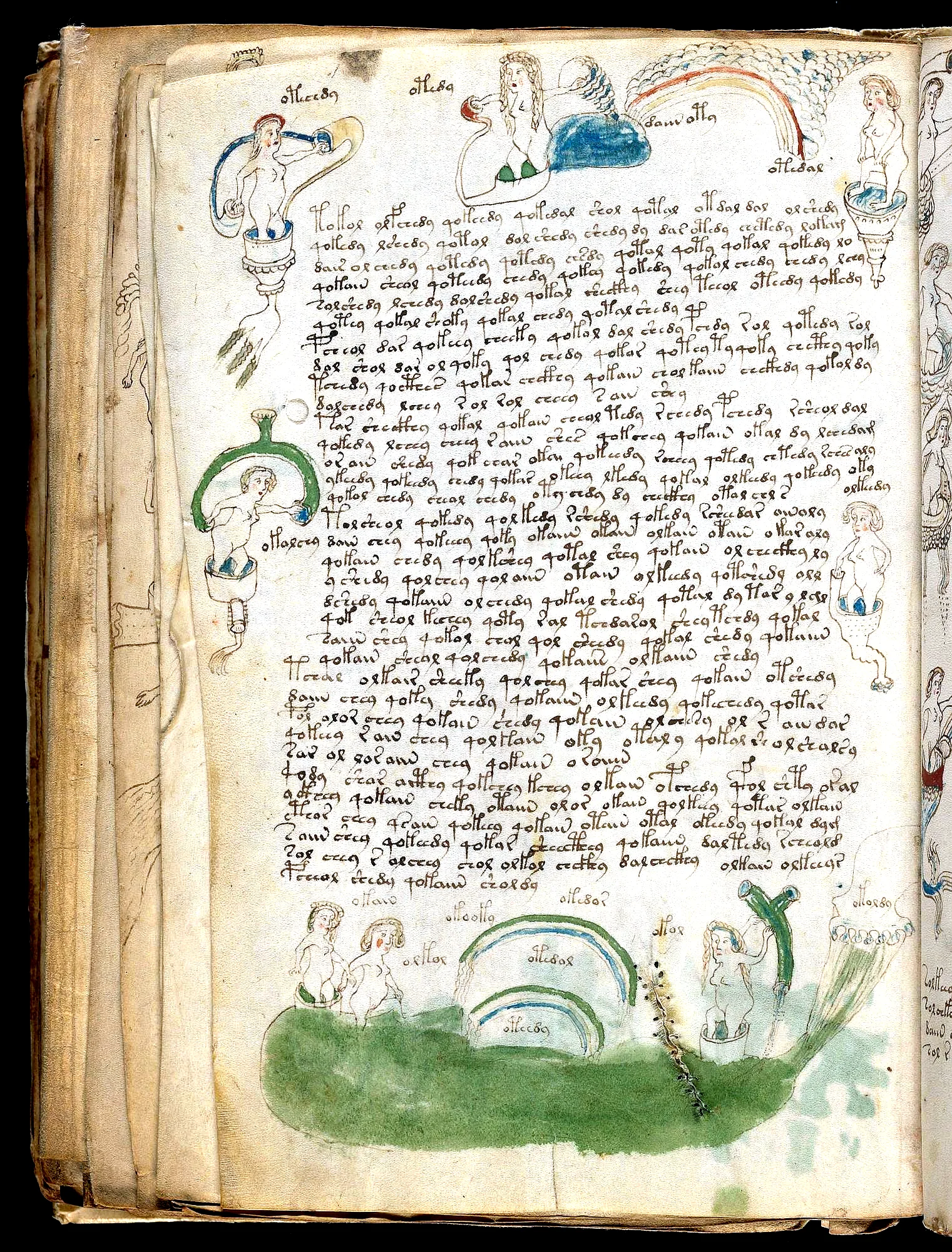
f75r The Grand Waterfall Bathing Pool & 8-Line Architectural Niche
Folio f75r (Yale PDF p. 136) · Click scan to zoom
SPEC-14 · Folio f75r (p. 136) · Balneological / Medical Bathing (f75r–f84v, Scribe 2) Tier A

The Grand Waterfall Bathing Pool & 8-Line Architectural Niche

De Balneis Puteolanis Balneological Hydrotherapy Architecture & Immersion Pool

Folio f75r is the grand visual frontispiece of the 20-page Balneological ('Bathing Nymphs') section. Look at how the drawing and the words lock together: a vaulted canopy pours a green herbal stream down a vertical chute into two communal immersion basins. Right inside the arch beside the chute, an 8-line inset note opens with dar olchedy ('from the source, pour into the infused bath'), while nearly 1 in 4 words (22.9%) in the main prose is a qo- thermal boiling verb (qokeedy = 'then boil') paired with shedy ('wash/bathe') and ol ('in the pool').

Visual & Manuscript Features
  • Upper vaulted/pleated fan canopy feeding a vertical green water chute in which 5 nymphs descend into a central immersion pool
  • Inside the white arch to the left of the waterfall chute sits a dedicated 8-line inset recipe column (dar olchedy / dary sheey...)
  • A single bather stands in a small individual tub at the right edge of the middle pool, while 9 nymphs stand and clasp hands in a lower-right green pool
Opening Headword:  / saino (Opening bath infusion & waterfall cascade stems)
Key Stems: qokeedy / qokedy (boil/decoct with heat · 22.9% of f75r prose!) · shedy / shol (wash/bathe in the stream) · ol / olchedy (in the bath pool / infused water) · dar olchedy (niche inscription: 'pour into the infused bath')
15th-c. Parallels: De Balneis (Italian illustrated medical bathing manuscripts showing vaulted hoods, chutes, and communal immersion basins)
Cross-Section Links: f76r (Master Balneological text treatise) · f78r & f82v (Overhead pipe and labelled nymph pages)
f82v Multi-Tiered Bathing Pipes With Explicit Tube (olkol / okoldy) & Nymph (okal) Labels
Folio f82v (Yale PDF p. 151) · Click scan to zoom
SPEC-15 · Folio f82v (p. 151) · Balneological / Medical Bathing (f75r–f84v, Scribe 2) Tier A+

Multi-Tiered Bathing Pipes With Explicit Tube (olkol / okoldy) & Nymph (okal) Labels

Labelled Hydrotherapy Conduit & Humoral Dosing Diagram (Polarity z = +9.97) Labelled Hydrotherapy Pipe Network & Nymph Array

Folio f82v gives us the smoking gun for how the 'Bathing Nymphs' diagrams work (z = +9.97). When the scribe writes a label directly on a painted water pipe, they write olkol or okoldy (ol- 'in the vessel/pipe' + kol 'core liquid' + -dy 'infused') · the exact same vessel stem (okol) written on the painted apothecary jars in the Pharmaceutical section! Conversely, active boiling commands like qokeedy ('then boil it!') are never written as pipe nouns (2.5% on labels), but pack the surrounding instruction paragraphs (24.4%).

Visual & Manuscript Features
  • Rows of bathing figures standing along green and blue horizontal water conduits and vertical shower pipes
  • Single-word Voynich labels are written directly alongside both the water pipes (olkol, okoldy, otol) and the individual figures (okal, otal, olar)
  • Proves the Label-vs-Prose Polarity Law (z = +9.97): pipe and nymph labels use o-/ol- nominal/vessel state forms (62.2%), while qo- active boiling verbs (qokeedy) are restricted to the surrounding prose paragraphs (24.4% in prose vs. 2.5% on labels!)
Opening Headword:  / okoldy (Direct labels written on the painted water pipes!)
Key Stems: olkol (the core bath-pipe liquid) · okoldy (infused in the vessel/conduit) · okal / otal (core/source essence label on bathers) · qokeedy (prose: 'then boil/heat the bath')
15th-c. Parallels: Michael Savonarola, De balneis et termis naturalibus omnibus Italiae (c. 1440s artificial & natural medicated showers/pipes)
Cross-Section Links: f75v & f78r (Sister labelled pipe & shower pages) · f88r–f99r (Apothecary jars using the exact same okol / okoldy vessel stem!)
f34r Split-Tuber Mandrake / Gentian Compound Hub (chckhy / chodaiin)
Folio f34r (Yale PDF p. 65) · Click scan to zoom
SPEC-16 · Folio f34r (p. 65) · Herbal B (Scribe 2 · Currier Language B Herbal Hub) Tier A

Split-Tuber Mandrake / Gentian Compound Hub (chckhy / chodaiin)

Gentiana lutea L. / Mandragora officinarum Botanical Monograph

While most of the early Herbal pages are written by Scribe 1 in Currier Language A, Folio f34r is a crucial 'Rosetta' plant page written by Scribe 2 in Currier Language B · the exact same hand and dialect used in the Bathing Nymphs section (f75r–f84v). Visually, it shows a massive two-legged split tuber beneath broad leaves and a red-and-blue flower spike; linguistically, it introduces qokeedy ('then boil!') and chodaiin ('take one infused dose') directly on a living plant page!

Visual & Manuscript Features
  • Massive, dark-brown bifurcated (two-legged) tuberous root base with horizontal ring striations
  • Broad, scalloped green basal leaves and a tall central flower spike with red-and-blue florets
  • Written by Scribe 2 in Currier Language Bright inside the Herbal section, acting as a direct vocabulary bridge to the Balneological and Recipe sections!
Opening Headword:  (p-ched-ar: 'Begin: infuse from the root base')
Key Stems: chckhy (concentrated double-core herbal infusion) · chodaiin (take one infused measure) · qokeedy (then boil thoroughly) · shedy (wash/bathe)
15th-c. Parallels: Tractatus de Herbis & Belluno Herbals: 'Gentiana / Mandragora' split-tuber monographs
Cross-Section Links: f75r–f84v (Balneological baths sharing Scribe 2's qokeedy / shedy dialect) · f88v–f89r2 (Pharmaceutical cut-root jars)
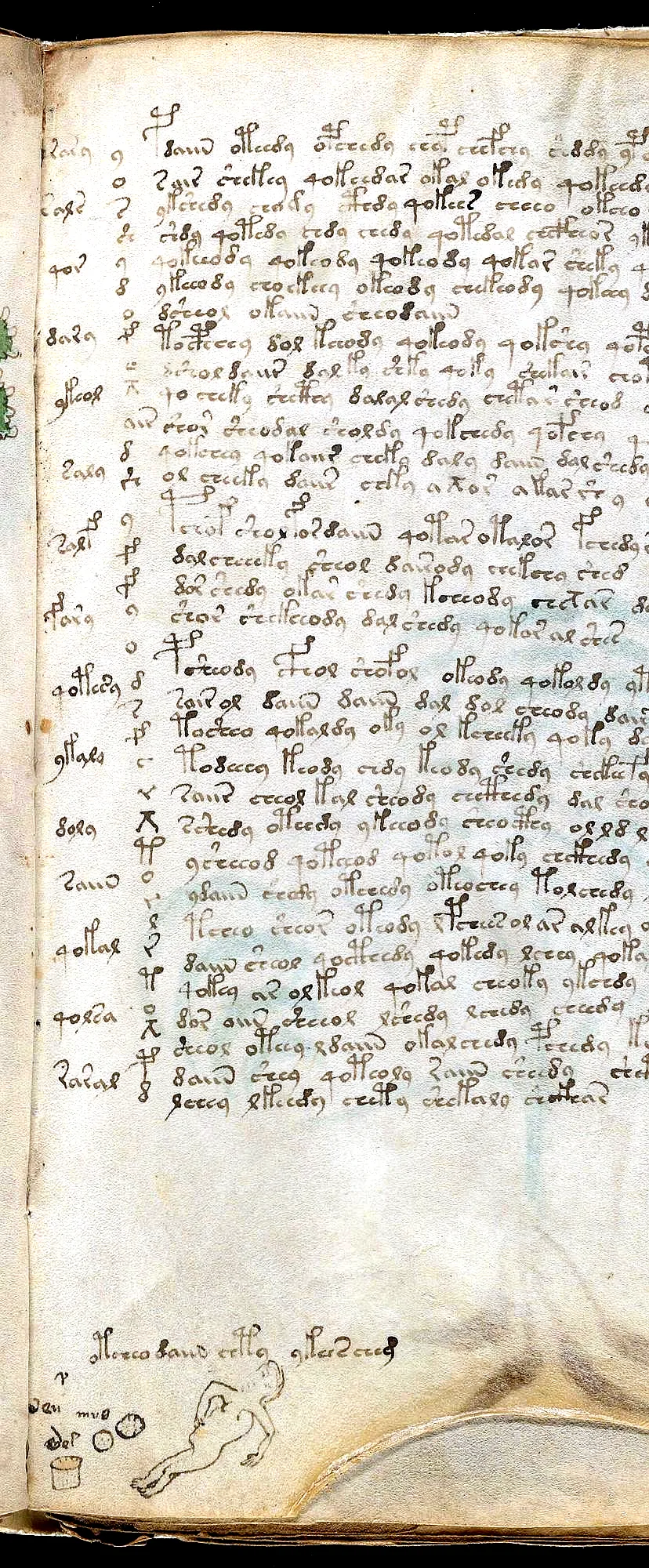
f66r The Margin-Indexed Clinical Treatise & Supine Patient/Humoral Diagram (den mus del)
Folio f66r (Yale PDF p. 119) · Click scan to zoom
SPEC-17 · Folio f66r (p. 119) · Biomedical / Astrological-Herbal Index (f66r, Scribe 4/3) Tier A

The Margin-Indexed Clinical Treatise & Supine Patient/Humoral Diagram (den mus del)

Gynecological / Humoral Clinical Index Directory Master Clinical Index Page, Marginal Column Key

Folio f66r is one of the manuscript's Six Master Index Directories (f1r, f49v, f58r, f58v, f66r, f76r), serving as the primary lookup table for 41 clinical and herbal pages. Look at the bottom-left margin: beside a vertical column of index letters sits a reclining figure surrounded by labeled vessels (otol, otar, olar) and the faint European corner note den mus del.

Visual & Manuscript Features
  • Down the left margin run vertical columns of single Voynich index characters and short words (o, y, d, s, r, air,als...) aligned with the main prose paragraphs
  • In the lower-left margin, a reclining human figure lies beside spherical vessels/organs with single-word labels (otol, otal, olar, otar)
  • At the very bottom-left corner of the page sits a 3-word European marginal note read by paleographers as den mus del
Opening Headword:  (t-air-or: 'From the air/volatile oil essence')
Key Stems: otol (in the liquid vessel) · otar (earth/root base) · olar (in the essence) · qokeedy / chedy (boil and infuse)
15th-c. Parallels: 15th-century German/Italian Gynecological & Humoral Practica (e.g., Trotula / Pseudo-Albertus Magnus)
Cross-Section Links: Indexes 41 target folios across Currier B Herbal, Balneological, and Starred Recipes (z = +6.32)
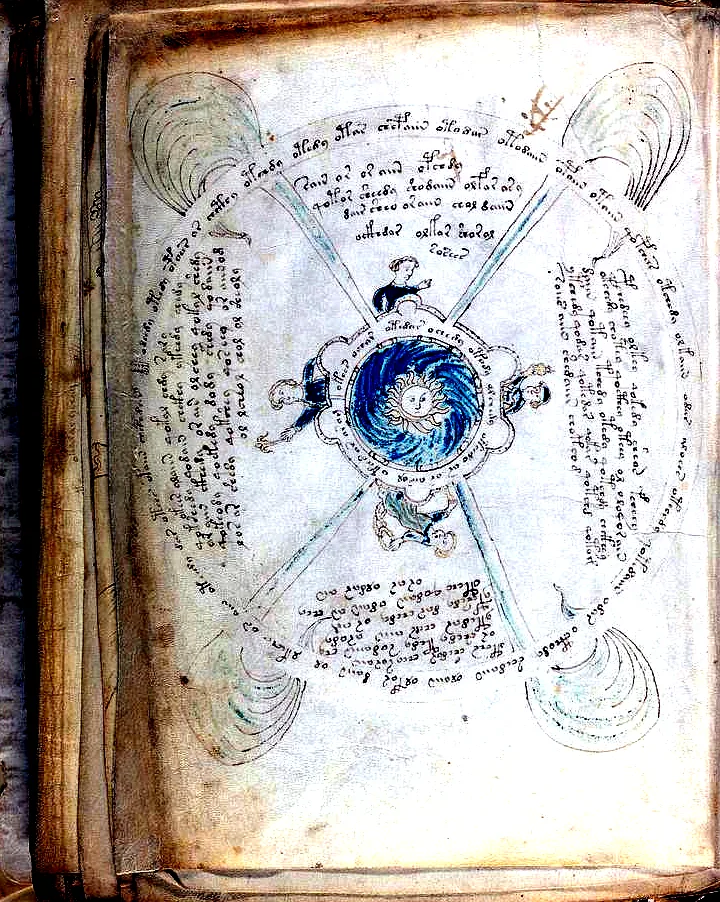
f85r2 The Four-Seasons / Four-Winds Solar Wheel
Folio f85r2 (Yale PDF p. 155) · Click scan to zoom
SPEC-18 · Folio f85r2 (p. 155) · Cosmological (Quire 14, f85r1–f86v6) Tier A

The Four-Seasons / Four-Winds Solar Wheel

Quattuor Tempora Anni / Quattuor Humores Four-Quadrant Solar Cosmological Wheel

Folio f85r2 is a textbook medieval Rota (wheel diagram) of the Four Seasons and Four Winds revolving around the central Sun. Our computational audit (z = +12.45) revealed a striking division of labor in Quire 14: on the wheel diagrams (f85r2, f86v4, fRos), over half of all words (52.1%) start with the nominal prefix o- (otar, okal, otol · naming the seasonal elements and essences), whereas on the facing text pages (f85r1, f86v3–v6), active qo- verbs jump 2.61x to explain how to use those seasonal essences!

Visual & Manuscript Features
  • Blazing human-faced Sun at the center of a swirling blue sky medallion, encircled by a scalloped ring of Voynich text
  • Four courtly figures emerge at the 12, 3, 6, and 9 o'clock cardinal positions (holding a flower/cup, golden vessel, etc. · the Four Seasons)
  • Four diagonal spokes terminate in four ribbed cloud/wind spouts at the corners, framing four triangular seasonal prose blocks
Opening Headword:  / okal / otol (52.1% o- nominal rate on Quire 14 Diagrams vs. 26.2% in Prose, z = +12.45!)
Key Stems: otar (earth/root quarter) · okal (star/air quarter) · otol (liquid/water quarter) · daiin (one measured part)
15th-c. Parallels: 15th-century Medieval Medical Rotae linking the Central Sun, Four Seasons, Four Winds, and Four Humours
Cross-Section Links: f85r1 & f86v3–f86v6 (Accompanying Quire 14 prose treatises where qo- active verbs jump 2.61x to 14.1%!)
fRos (f85v2–f86r2) The 9-Sphere Rosettes Foldout Map (Center Sphere With 5 Onion-Domed Alembics/Towers)
Folio fRos (f85v2–f86r2) (Yale PDF p. 159) · Click scan to zoom
SPEC-19 · Folio fRos (f85v2–f86r2) (p. 159) · Cosmological / Alchemical Foldout (Quire 14, p158–p159) Tier A

The 9-Sphere Rosettes Foldout Map (Center Sphere With 5 Onion-Domed Alembics/Towers)

Nine-Sphere Astro-Medical & Alchemical Distillation Map Nine-Sphere Foldout Map & Alchemical/Hydrological Router

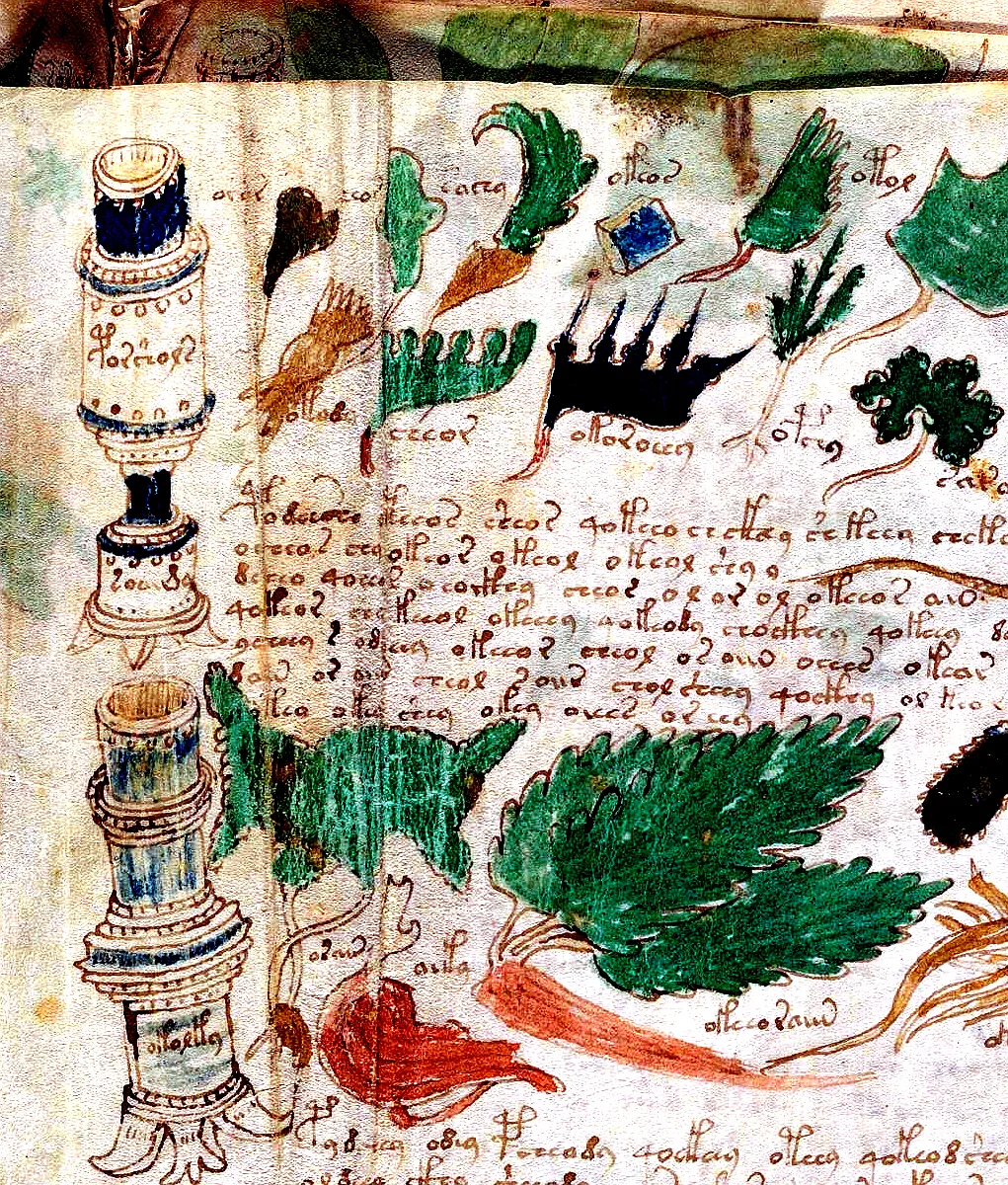
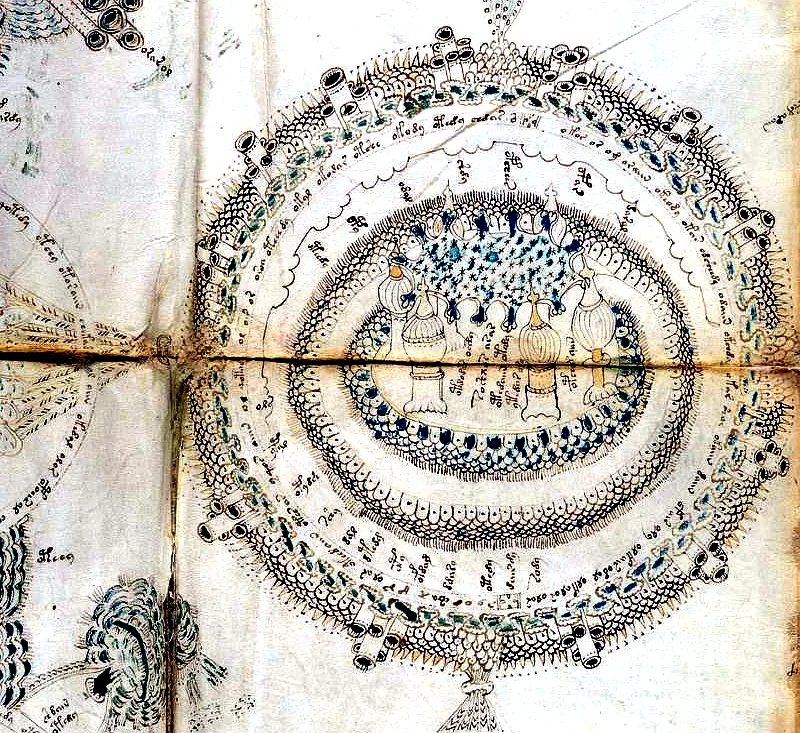
The 9-Sphere Rosettes foldout (fRos) is the grand visual synthesis of the Voynich Manuscript. Look at the zoom of the Central Sphere above: five onion-domed vessels/towers sit in a blue star-filled basin ringed by twin water spouts, with Voynich labels written right between their bases. Across the corpus, 64.0% of all words written on the Rosettes map appear word-for-word in the Starred Master Recipes (f103r–f116r) and 63.2% in the Herbal section · showing that the 9 spheres map how raw earthly and stellar essences are distilled and routed into finished medical preparations.

Visual & Manuscript Features
  • Giant 6-page fold-out vellum sheet containing 9 interconnected circular spheres linked by causeways, water channels, castles, and volcanic/alchemical spouts
  • In the Central Sphere (shown above), five bulbous onion-domed towers / alchemical alembics rise from a blue star-spotted basin, with vertical Voynich labels written right between their pedestals
  • Outer scalloped ring bristles with twin cylindrical spouts (olkol / otol conduits) matching the Balneological bath pipes!
Opening Headword:  / okar / otol / okol (Ring & alembic pedestal labels)
Key Stems: otol / okol (alembic vessel / liquid conduit) · otar / okar (earth/core essence) · okal / osal (volatile star/seed essence) · qokeedy (boil/distill in corner prose)
15th-c. Parallels: 15th-century Northern Italian Cosmological Mappae & Thermal Spring Cartography (Padua / Euganean Hills / Venice)
Cross-Section Links: 64.0% of all tokens on fRos appear verbatim in the Starred Master Recipes (S) and 63.2% in the Herbal Monographs (H)!
f107r Alternating Dark/Light Star-Bulleted Master Formulary
Folio f107r (Yale PDF p. 195) · Click scan to zoom
SPEC-20 · Folio f107r (p. 195) · Starred Master Recipes (Quire 20, f103r–f116r, Scribe 3) Tier A+

Alternating Dark/Light Star-Bulleted Master Formulary

Antidotarium / Receptarium Star-Bulleted Clinical Recipe Formulary (285 Recipes)

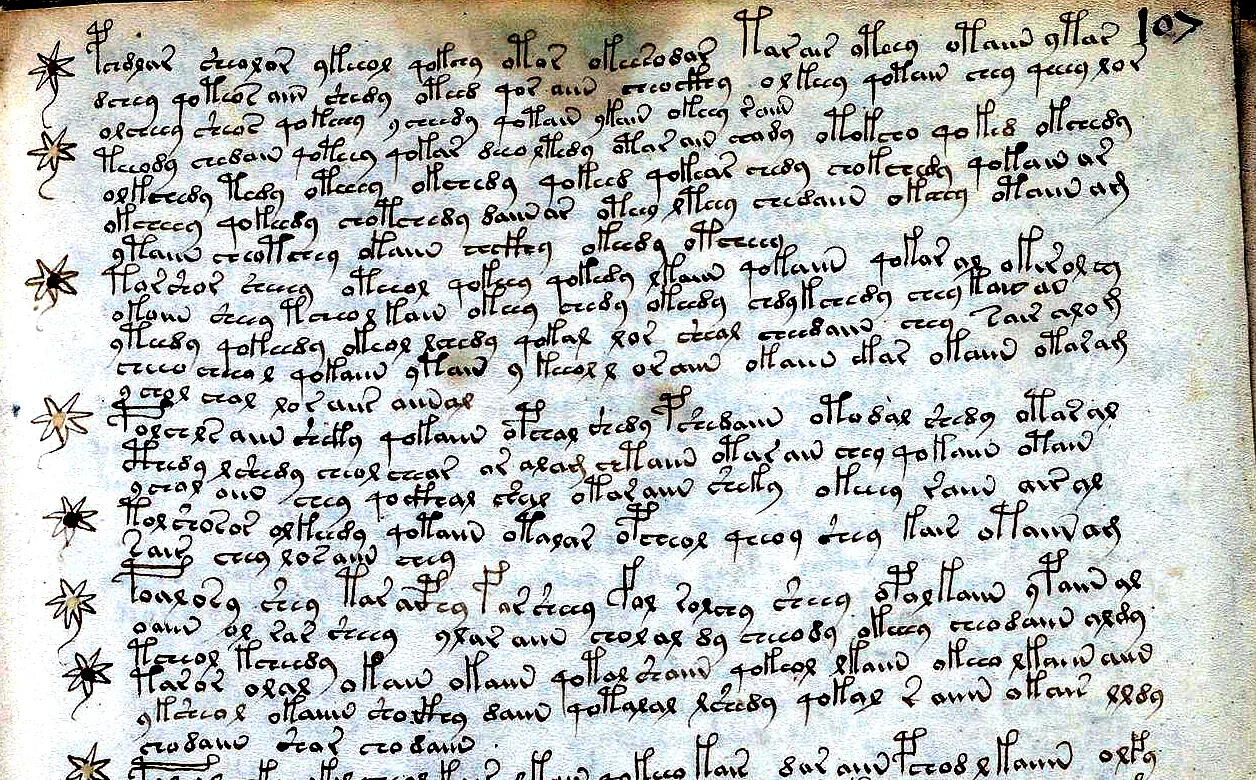
Folio f107r shows how the final section of the Voynich Manuscript (f103r–f116r, containing 285 star-bulleted paragraphs) works as a practical medical recipe book (Antidotarium). Look down the left margin: the artist alternated dark-centered and light-centered stars (★) so the apothecary would never lose their place between recipes. Every single recipe follows a strict 3-part frame (z = +18.93): open with a tall Gallows declaration (pchedar...), execute the boiling and dosing steps in the middle (qokeedy... daiin), and close with an -am/-m stop word (otam / okam).

Visual & Manuscript Features
  • Eight consecutive recipe paragraphs down the page, each introduced in the left margin by a painted tailed star (★)
  • The star centers strictly alternate Dark-Red/Solid → Light-Yellow/Open → Dark → Light down the margin to visually separate adjacent prescriptions
  • Every recipe opens with a tall Gallows header word (p-/f-/t-/k-, 19.5% in Opening 20% vs. 6.3% in Middle) and closes with an -am/-m terminal stop (3.9× surge at recipe end, Frame z = +18.93!)
Opening Headword:  / tchedy / qokeedy (Gallows recipe opener + active boiling/infusing steps)
Key Stems: qokeedy / qokedy (then boil thoroughly) · chedy / chol (infuse in strained liquid) · daiin / qokain (take one measured dose) · otam / okam (seal/complete the prescription)
15th-c. Parallels: Antidotarium Nicolai & 15th-century Italian Hospital Receptaria (paragraphed compound prescriptions)
Cross-Section Links: Collects and compounds the exact botanical stems introduced in Herbal (f1r–f57v), timed by Zodiac (f70v2–f73v), and stored in Pharma Jars (f88r–f102v)!
1 – 20 of 115