 Click scan to zoom
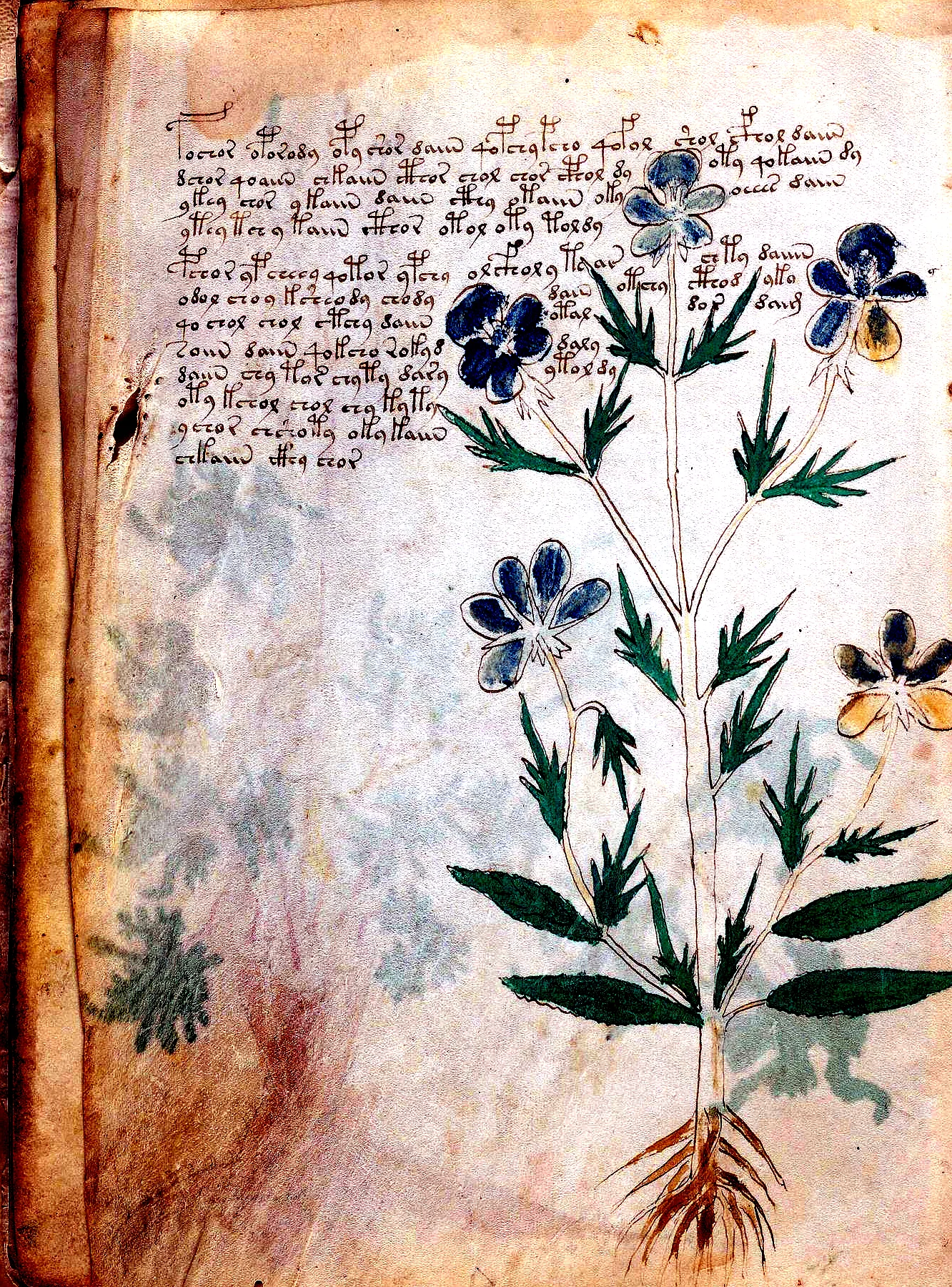
Wild Pansy / Heartsease (Viola tricolor)
Full-page botanical paintings occupy the first half of the manuscript, pairing painted roots, leaves, and blossoms with structured preparation notes.
An interactive companion to our ongoing exploration of Yale’s Beinecke MS 408, examining the 15th-century Voynich Manuscript as an illustrated herbal, astronomical almanac, and balneological recipe book.
Preserved at Yale University’s Beinecke Rare Book and Manuscript Library as MS 408, the Voynich Manuscript is an illustrated codex handwritten on early 15th-century vellum (radiocarbon-dated to 1404–1438 CE). Across 227 surviving parchment leaves (~240 pages) and 38,949 words, five scribes wrote in an unfamiliar glyph alphabet alongside hand-painted botanical herbs, astronomical star wheels, Zodiac calendars, bathing pools, and apothecary jars.
Physical evidence on the pages shows the book was painted first and written second: scribes broke their text lines 758 times to flow around pre-existing plant stems, roots, and bathing nymphs. Short labels written directly onto painted roots (such as oror on blood-red Alkanet root or darary on main taproots), storage jars (okol), and Zodiac figures reappear inside the surrounding recipe paragraphs.
Click scan to zoomFull-page botanical paintings occupy the first half of the manuscript, pairing painted roots, leaves, and blossoms with structured preparation notes.
 Click scan to zoom
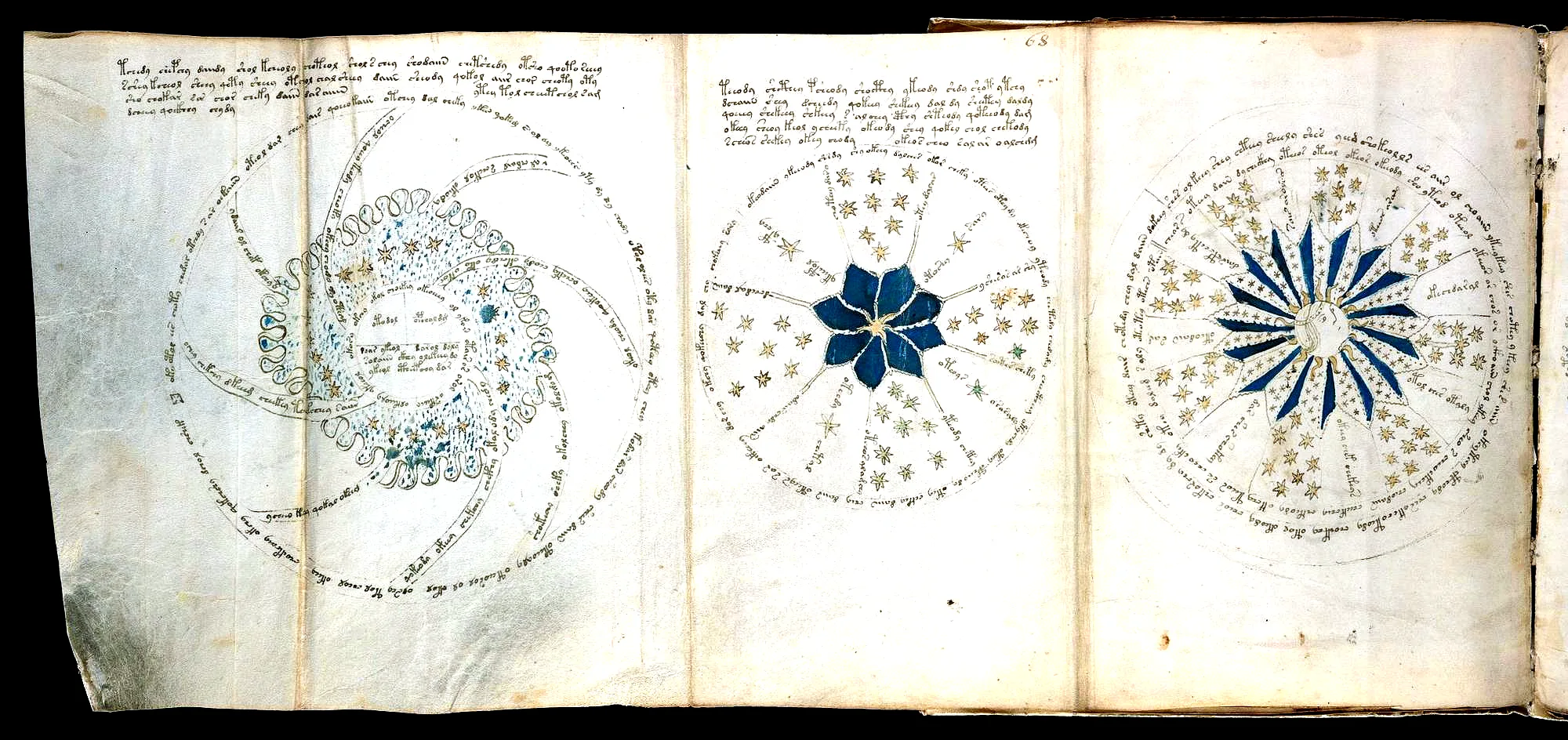
Foldout star charts and 30-degree Zodiac wheels containing 15th-century European month names (mars through decembre) act as a seasonal timing calendar.
 Click scan to zoom
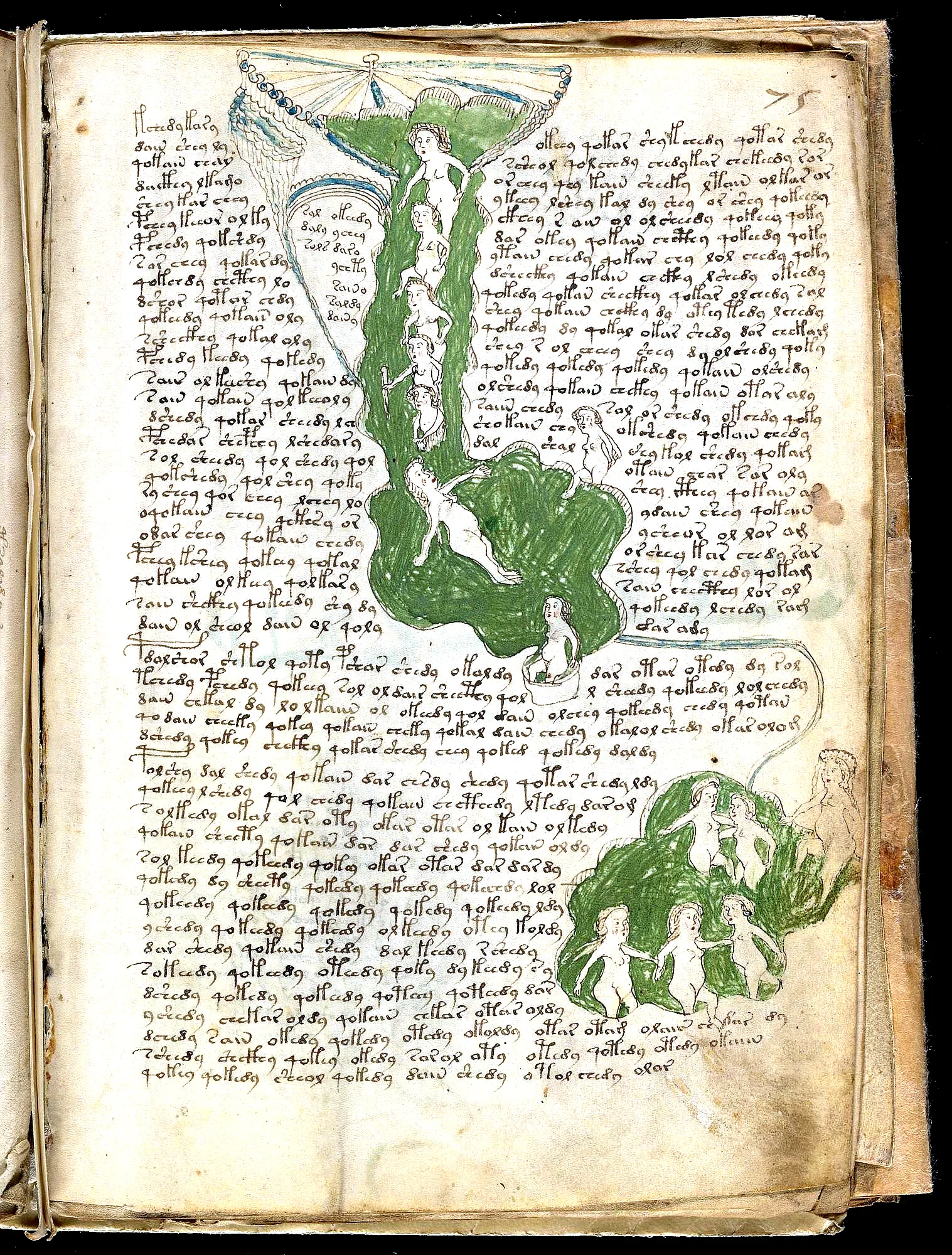
Twenty pages of chutes, pipes, and immersion basins where painted conduits carry vessel labels (olkol, okoldy) and surrounding recipes prescribe boiling and bathing.
 Click scan to zoom
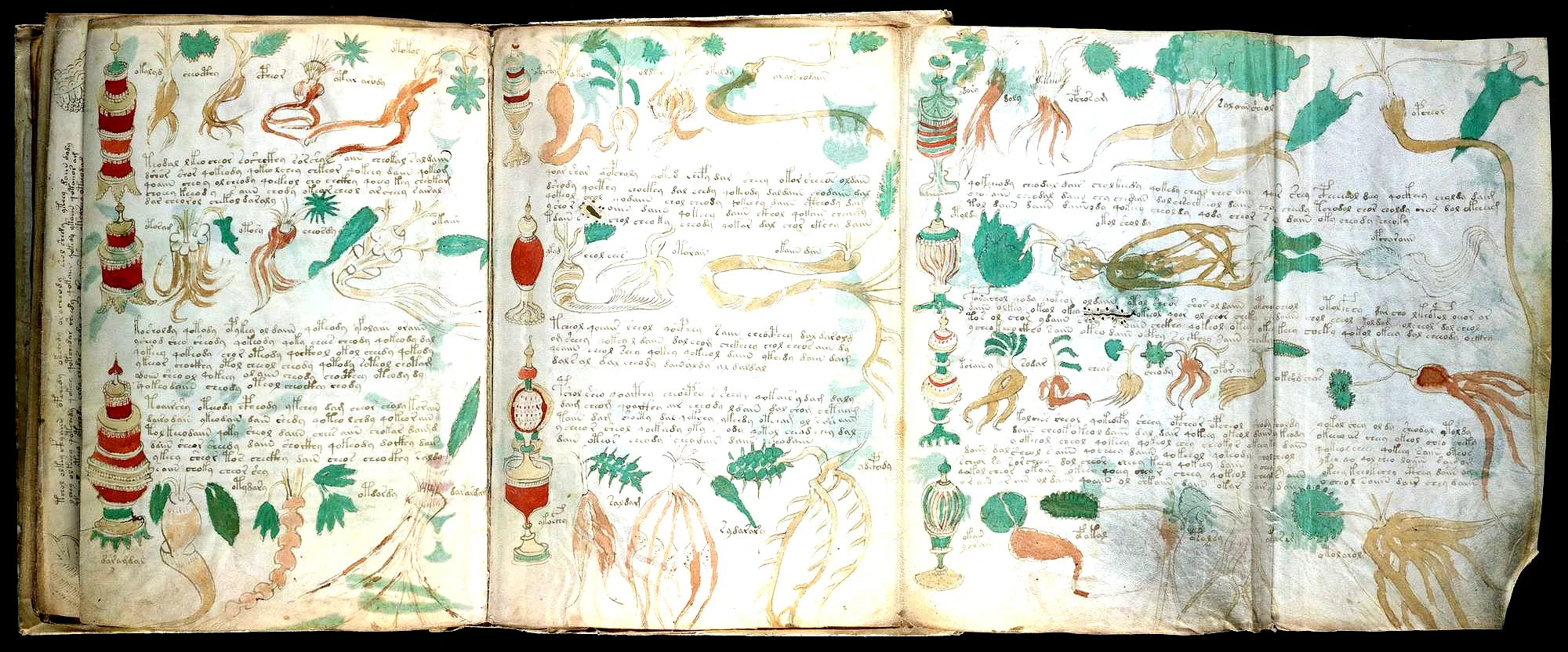
Painted storage jars sit beside dissected root and leaf cuttings (darary, okar, oror) that bridge the botanical herbals to the final starred recipe pages.
Everything presented in this app is part of our own curiosity-driven exploration of the Voynich Manuscript. Our goal is to make the manuscript’s illustrations, transcriptions, and recurring word structures easy to inspect firsthand and to spark curiosity about one of history’s most fascinating books.
Please treat these readings as an exploratory hypothesis rather than a settled decipherment. Many dedicated historians, paleographers, linguists, and independent researchers have devoted decades of their lives to studying MS 408 in far greater depth. We strongly encourage you to explore their work and the primary archival sources as well:
Jump into the annotated page walkthroughs, botanical identifications, or plain-English guides in the library, or inspect the complete 227-folio transcription and grammar tables.
Step-by-step annotated readings of key manuscript pages with high-resolution scans, object labels, and clause-by-clause plain-English readings.
Illustrated plants, roots, and star clusters compared against 15th-century European herbals, pigment cues, and apothecary jars.
Reference tables for recurring root stems, the 8-case morphological matrix, the 12 Zodiac wheels, and the 20 hydrotherapy pages.
Read the Plain-English Visual Reader’s Guide and thematic monographs, or inspect all 258 raw JSON and TXT verification datasets.
Browse all 477 Yale Beinecke manuscript page scans in the zoomable gallery or download the full Public Domain PDF books.
Search and filter every transcribed page of Beinecke MS 408 by section, scribal hand, or Currier dialect with interlinear stem glosses.
In the European Voynich Alphabet (EVA) transcription, most words are built from three recurring parts: a Prefix (procedural action or role), a Root Stem (botanical ingredient, star cluster, or vessel), and a Suffix (grammatical role, liquid medium, or measured dose). Click any sample word below or type your own to see how our model breaks it down.